Posts in the Parenting category offer a realistic and honest look at parenting from a Biblical perspective. You’ll find helpful, practical, funny and encouraging topics for Christian moms.
You can find content specifically for the following age groups:
A study in March 2015 showed that parents are spending more time with their children now than ever before. In fact, the amount of time we’re spending with our kids keeps increasing. But, if you talk to most parents they don’t feel like they are actually spending enough one-on-one time with their kids. I’d guess that’s because the research is looking at quantity of time more than quality of time.
It’s a struggle that my family faces. Both of our kids are in school now. With a third grader and kindergartener, we are careful of monitoring their after-school activities so we don’t get too busy. Each of them are allowed to pick one extracurricular activity that goes for the entire school year. We recently agreed to let them both participate in a school play knowing that it would increase their activities for a couple of months, especially for our daughter who, as a third grader, has a larger part than her kindergarten brother.
Once you add in things like homework, making dinner, making lunches and cleaning up from everything, our evenings are pretty full even when the kids don’t have any activities. We are together and have family dinner almost every night. We chat around the dinner table, which is something my husband and I set as a priority when we first became parents. But when it comes to actually having one-on-one time with our children, we have to be more intentional.
One-on-one time is so important for our kiddos. I can literally see the difference in my children’s attitudes and mannerisms when they learn that they get one-on-one time. They perk up. It doesn’t take a long time or something complicated to make a difference. It just takes a bit of planning and undivided attention (no cell phone!).
1. Share a meal.
I can almost bond over food with anyone. I love food! But, this is true with my kiddos. I love getting a chance to eat with just one kiddo at a time. We’ve done this both as one-on-one time with each other individually and also as one-on-two time with both my husband and me but only one kiddo.
Right now in being busier, we actually are able to accomplish this one more. One night this week, for example, my daughter had play practice until 6 and had to be at gymnastics at 7. My son had to be at his Ninja Zone class at 6:30. My husband and I divided and conquered. He took my daughter and had dinner at Subway in between activities. I had my son who wanted frozen pizza at home before his class. It was a great opportunity to connect with our kids individually.
Another way I’ve found this works well is going into have lunch with them at school. My kids’ school is open to having parents come in for lunch whenever they’d like to as long as we sign in. My son’s lunch ends right as my daughter’s is beginning. And there are special tables just outside the cafeteria we can sit at, which really does give us a chance to connect one-on-one. I also really enjoy seeing them in their element at school and interacting with their friends. I also keep it simple and usually just have them eat their lunch that I packed for them.
For the one-on-two dates, we have even left one kiddo with a babysitter and gone out. A babysitter for us means grandparents because we are fortunate to have both my parents and my in-laws living within 10 minutes of us. But, even with grandparent time, our kids still make us promise that they’ll each get a turn to go out with us one-on-two. They enjoy having our undivided attention.
2. Take advantage of time in the car.
That scenario above where the kids have classes within a half hour of each other happens every week. My son’s Ninja Zone class is 6:30 to 7:30 p.m. and my daughter’s gymnastics class is 7 to 8 p.m. Both classes are in different buildings about 10 minutes away from each other. So my husband and I split up to take them. We alternate who goes with whom so we have a chance to see each of them do their thing.
I’ve had some great conversations with both of them on the way to and from classes. Sometimes they share more about what’s going on with them at school. Sometimes they tell me something they’ve been worried about. And sometimes, especially with my son, they tell me about all the plans they’re making. (I call my 6-year-old son “my little man with a plan,” because has a plan and explanation for everything, even if he’s taking creative license with it!)
3. Go on dates.
We get to have dates every so often around here with our kiddos. For the past two years, a local community organization hosts a daddy/daughter dance in the fall. My husband takes my daughter and they always have a great time together. My son and I plan our own date during that time. In fact, I wrote about our most recent back in October. We don’t have to do something extravagant. My son really just wanted to go to the playground and out for ice-cream. But we have fun and get to connect in a different way. We get to chat about what’s going on with them and we try to make sure that we are doing something they are interested in and want to do, which is also incredibly important.
4. Take turns playing.
Our kiddos love for my husband and I to play with them. Now that they are both in school and have more going on, we don’t get to play nearly as often as we once did back when they were itty-bitties. But something we started back then has continued until now and is still one of their favorite things: one-on-one play time. We set a timer and spend time with each kid playing whatever they want to play and then switch.
My kids love this so much that it was their only requested activity over winter break when I asked them what they wanted to do during their time off from school. Even just a half hour each is enough and they love it. My husband and I do, too.
5. Go shopping together.
You don’t have to love shopping for this one to work, because I certainly don’t love shopping! I’ve enjoyed numerous shopping trips with one kiddo at a time picking out presents for the other or even just shopping for clothes. There’s something special about being out with just one kiddo at a time for both them and me. A couple of weeks ago, my son and I went to Target to have him try on jeans. It was sort of laborious and shouldn’t have been fun, yet we had a good time together anyway.
My son’s birthday is next week. Boy that comes quick! We’ve been doing some birthday planning around here. I try to work ahead with my kiddos and ask them a month or two ahead of time what theme they have in mind (both have picked themes previously that didn’t have party supplies made commercially and required me to get creative). That also gives us time to talk about and fine-tune the theme to make sure it’s practical and do-able as well!
We have some of our own birthday traditions our whole family really does enjoy. Along the way of having kiddos and planning parties, I’ve learned a few things that work well and figured I’d share them with you, because we’re in this together!
My overall birthday party philosophy is to make sure I plan a party my kids and their friends will enjoy. I have found numerous decor ideas and snack table ideas and so forth on Pinterest that I know kids won’t really care about. I don’t care if I impress the other moms who come to my kids’ parties. I care if my kids and their friends have fun! This perspective helps me remember what matters most (my kiddo feeling special and having fun on his or her birthday) and reduces my stress level and pressure I feel to create a perfect party with lots of small details.
Think about your budget. This is pretty much where everything always starts, isn’t it? You’ve got to know how much money you are comfortable spending in order to plan well. Personally, I tend to stick with a lower budget because it just makes sense to me for a kid’s party and there’s so much you can do without breaking the bank. Consider costs for the location, food, paper products and treat bags.
Figure out your space. Obviously you’ve got to have somewhere to have the party. For me, not having it at home is the very best plan. Having it at home adds lots more stress for me. I’m not sure that’s true for everyone, but I’m guessing it’s true for most of us. So figure out where you’re going to have the party. Go back to your budget and decide if you want to pay for a venue and if so what might work with your budget as well as how much space you need and how many people you want to include.
For the first friend party we threw for our daughter, we went to a local bowling alley. It was fun for her but it also meant that we had to keep the guest list smaller and that we weren’t able to have ice-cream because they didn’t have a freezer. But on the other hand we didn’t have to have plan any activities (because bowling!). Since then we have opted to have our parties in our church gymnasium. It’s been a great fit for us because there is lots of space inside, great parking outside and a kitchen we can use.
Decide on your guest list. Before you mention it to your kiddo, think first about your budget and where you are planning to have the party. Are you having it at a venue that offers a limited number of spaces for kids parties? Are you having it at home and only have room for a few kids? Are you having it somewhere that you can invite as many kids as your child wants? Once you have an idea of about how many kids you are thinking to have, start talking to your child about it. I have done both options of giving my kids a specific number that we have to stay with and just asking them who all they want to include. It totally depends on your situation. Now that we use the gym at church, I don’t give them a set number, but we do pay attention to who they want to invite.
I try to encourage them to include friends they spend time with and enjoy. I’m less inclined to invite the entire class. I like the kiddos to pick kids they will play with, interact with and have fun with. Of course, I’m also an introvert, so I tend to think smaller gatherings are better anyway. That may be just the opposite for you and your family and that’s totally fine! You just need to know up front.
Get out invitations at least two weeks before the party. I think the earlier invitations go out, the better. If you can get them out a month ahead of time, go for it! I have done invitations three different ways. For my daughter’s first friend party, I sent them out via email with a Google form to RSVP. That wasn’t as successful.
Facebook has worked well for some party invitations. I have done that more for my daughter because she has been with the same basic group of kids since kindergarten. And now that she’s in third grade, I am either friends with their parents on Facebook or can easily find them. So I just make a Facebook event and invite people that way.
Paper invitations also work. In fact, for my son’s party I went the paper route. You can buy invitations and fill them out or make your own and print them. I printed ours. Be sure you don’t forget information and include the date, time, location (with address) and contact information for RSVPing (I usually do my cell phone number and email address). I have also included before whether parents were welcome to drop off and leave the kiddos or if they needed to know anything else. For example, when my daughter had an art party a couple of years ago, I noted on the invitation that they might want to wear something that would be OK to get washable art supplies on.
Decide on activities. We have a pretty set format for our parties. One of the popular stations that works no matter what the party theme is a coloring table. I print out some coloring sheets are geared toward the theme and put out some crayons. When the kids come in, they immediately have something they can do. Good to see you! Want to color? I leave it set up throughout the party so that if kids want to go back to their coloring they have that option.
I try to plan about two organized activities or games thinking about the age range of kids I have. My daughter (for whom we’ve had the most friend parties because she is older) tends to like activities more than games, but we have done both. For her art party, we had craft stations. For her baby doll party, we basically played lots of pretend and asked the guests to bring a doll or stuffed animal and they could do different things like a diaper toss game but also sit at a table with doll food and feed their “babies.” This past year, she wanted a Barbie and beauty theme, so we had nail painting and lip gloss making.
My son, on the other hand, is younger and more active. He likes games. We have done a version of pin the tail on the donkey that was pin the fire on the dragon for his dragon-themed party. At the same party, the kids swung at a dragon pinata with a toy sword to slay it. I try to keep it simple. But, I do find that having one or two organized activities helps keep the kids engaged and having fun.
Once you’ve decided what to do, then decide your order. We typically do games and activities first, which take about an hour. Then we have snacks for about 30 minutes before finishing the final 30 minutes with opening gifts.
Don’t forget food! Of course you need food at a party. I usually plan my parties for 2 to 4 p.m. so we can offer snacks but don’t have to serve a meal. This is my plan for two reasons. First, my own kids don’t like stopping their playing and fun for eating all that much. So they want things quick and easy rather than having to sit longer and eat a meal. Second, it’s cheaper.
The biggest thing I do with food is make sure it is what the birthday kid likes. My daughter — bless her heart — doesn’t like cake or icing very much. (I’m still trying to figure out how she belongs to me!) So we don’t have cake. The last two years we had doughnuts instead. (I got all the same yeast doughnuts and then got her a bigger one to put a candle in.) One year we did an ice-cream sundae bar.
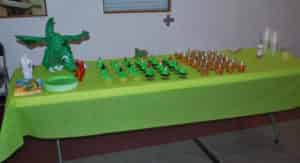
These are the cupcakes I made for my son’s dragon party. I topped enough of the kids’ ones with small dragon figures so they got an additional party favor that way. I’ve also used rings as cupcake toppers. This year I’m using small cake pop sticks with printed images of Miles Morales from “Spider-man into the Spider-verse” on them at my son’s request.
My son, on the other hand, loves cake. I usually bake the cake for him because I love baking and it does save funds. Cupcakes are my go-to for kid parties because they are easier to serve. I usually do chocolate and vanilla cupcakes with vanilla icing. They look fancy if you use an icing bag and just plop it on top with a tip so it kind of swirls, but you can totally just use a butter knife or spatula and smear it on. I also like the individual ice-cream cups to serve the ice-cream instead of having to scoop it out. But, you can definitely scoop it out as needed or into small plastic cups or bowls ahead of time.
Along with the sweets, I offer other kid-friendly food. Goldfish are always popular. Sometimes I do pretzels, too. For my daughter’s party we also had cheesy puffcorn and it was a huge hit. I try to offer a fruit of some sort as well like grapes or strawberries. My husband and I station ourselves at the food table when it’s time for snacks and help the kids make their plates, especially at younger ages. We also simplify where we can. Like for my son’s party last year, we used punch cups and filled them with some pretzels and Goldfish so the kids could just grab a cup of them instead of having to scoop them out.
For drinks, we keep it simple and usually have a pitcher of lemonade (with back-up to refill the pitcher) and a jug of water. For my daughter’s baby doll party I did make punch and floated some brand-new, clean rubber ducks in it, though.
Decorations don’t have to be elaborate to be fun. Some moms are super great at decorating and crafting. I am not one of them. While I can easily make the cupcakes because I love baking, I can’t easily make lots of decorations. Maybe you’re the opposite. If so, go with what works for you. Almost always it’s easier on the budget if you can make something versus purchase it.
This was our table setup for the dragon party last year as well. I found the inflatable dragon for a couple of dollars to add some fun. And my son played with that dragon for a couple of months afterward!
My decoration plan is simple. I buy a plastic table cloth for the food table that matches the theme or colors. I buy the matching plates and napkins and cups of a similar color. I buy a birthday banner that matches the theme and hang it. Sometimes I use crepe paper and balloons we blow up ourselves for the door leading into the gym so people know where to go. I will say that I’m not a mom who lets the kids play with balloons because I have crazy balloon anxiety and can’t handle it. Otherwise, we usually end up making some decorations to hang up that are coloring pages for the theme that we color and glue to construction paper. The kids like being involved with this and it’s fun to see their artwork on display.
Plan for some extras. Once I’ve made the list of kids to invite, I tally our numbers, including siblings for families we know. For example, when we invite children from church, we usually know the entire family and expect all the children will come. When we invite children from school, we know they may or may not bring a sibling along. So I always make sure to plan for a few extras, because if someone brings a sibling or a cousin visiting for the weekend or whatever, I don’t want them to feel left out when it comes to treat bags or activities. I also make sure to have an idea in my head of how many parents may be there and plan enough food to make sure everyone can have snacks.
I like to fill treat bags with stuff I know my kids would like and actually use. I try to stay away from all candy, because I don’t like all-candy treat bags for my own kids. I like things like stickers, notebooks, temporary tattoos, fun erasers, pencils and small toys. I do usually include a couple of small pieces of candy as well. I look for things I could say yes to my kids eating one or two of after going to a party and eating sweets there.
Make sure you have enough help. As you assess your venue, number of children, activities and food, think about how much help you’ll need. While my husband and I work well together and get things covered, I’ve found that having my parents come along as well is incredibly helpful. For my daughter’s party last fall, for example, I ran out of time to clean and cut the strawberries, so my mom did that while I set up the party. She also helped with nail painting while I manned the lip gloss making table. Sometimes asking extended family or friends to come along and help makes life so much easier.
Assign someone to take photos. Who doesn’t want lots of photos of their kids’ birthdays?! With the digital age we don’t have to worry about going through too much film either. Sometimes I use my cell phone, but for their parties I tend to take our digital camera instead. Either way, though, I ask someone else to take some photos. My parents are helpful with that. I want photos, but I can be so busy helping the kids through games, activities, snacks and opening gifts that I don’t get a chance to take many. Having someone else do that for me has been invaluable. With that said, think about what kind of photos you want to have. I always like one of the kids by the birthday banner before everyone arrives. I usually try and take photos of the decorations that way as well. And, of course, I want photos with the candles on the cake (or doughnut!) and while they’re opening gifts. I also like to get a photo of all the kids together. Usually I bribe them and do this after activities, but before snacks so I can say something like, “If you want cake, come over here for a photo first.” Ha! It works!
Studies abound about the benefits kids glean from having predictable routines at various ages. For example, a 2016 study from The Journal of Applied Developmental Psychology found that people who had predictable routines in childhood were more likely to have better time management skills and attention spans in adulthood.
The studies continue on and on from researchers who specialize in such things. I can just tell you that as a mom, I’ve found routines to be invaluable to our family’s happiness. My kids thrive when they know what to expect and how things will go. I think we all end up happier and even getting better rest with maintaining a few routines.
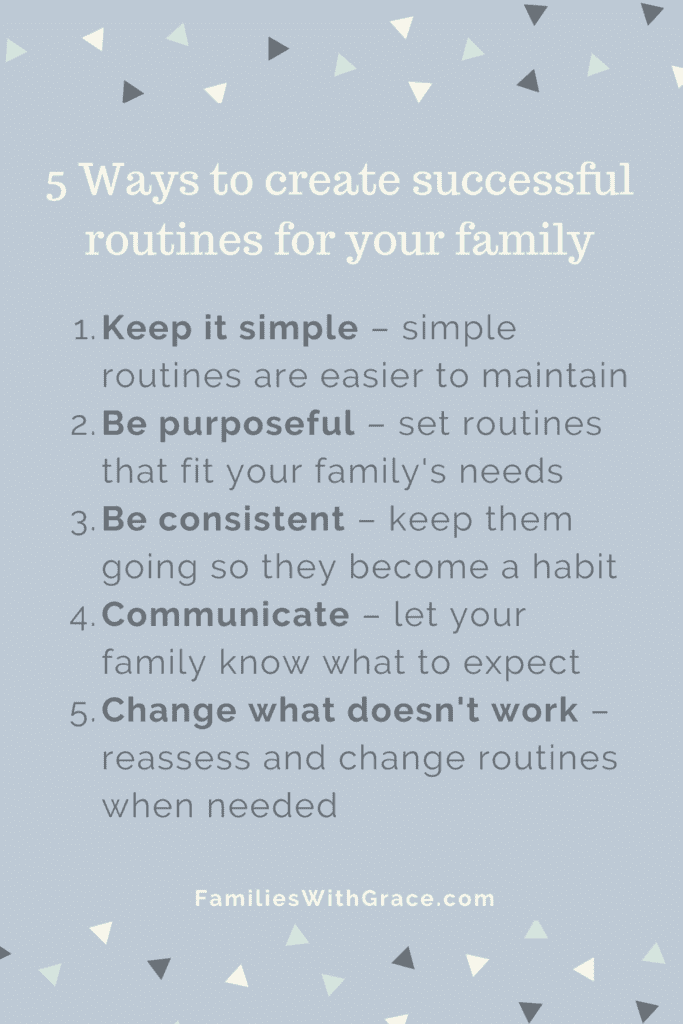
1. Keep it simple.
When it comes to routines, the simpler the better because that makes them easier to maintain. During my daughter’s toddler days as we were really getting settled into a bedtime routine, my husband and I talked about what we wanted to do each night and how to keep it simple. We opted not to include a bath in our nightly routine because giving a bath every single night just wasn’t going to happen.
So we decided on prayer, a book, two songs and then being tucked in. Nine years later that routine is almost exactly the same. We don’t do the songs any longer, but we pray, read and tuck in every single night.
This has varied a bit through the years as the kids have grown. When they had different bedtimes and were farther apart cognitively, we did things differently. They each had their own version of this bedtime routine.
Since moving into our new house, we have shifted so that both kids do their bedtime hygiene routines and then head to a bedroom where they both pray, we read a book out loud (usually a chapter of a book these days) and we exchange hugs and kisses all around.
2. Be purposeful.
Don’t create a routine just for the sake of creating one. Our bedtime routine, for example, helps our kids wind down each evening because they know what’s coming and it’s how they’ve always gone to bed.
Other routines are more out of necessity. Like school mornings mean I wake up the kids and they go to the bathroom, get dressed and style their hair before coming to breakfast. The night before, I lay out clothes for them (complete with undies and socks) so there is no scrambling around in the morning trying to decide what to wear.
Everything has a purpose. They get dressed first because they can take their breakfast in the car if they have to but they can’t change clothes in the car on the way to school. It also gives me time to make their breakfast while they are doing their tasks. And every morning they know what to expect so our mornings are pretty calm.
3. Be consistent.
This sounds obvious, but in order for a routine to work and stick, you have to be consistent. While research can’t completely agree on how long it takes to form a habit (anywhere from 7 to 66 days!), it does take time. And that means you have to be consistent even when you don’t feel like it.
Our bedtime routine, for example, took us working at it every single night to make it happen. I won’t even pretend that it always runs smoothly even now, because kids are kids and get distracted. Just the other night I had to tell my son to stop foot attacking his sister and brush his teeth because the kiddos were goofing off a bit.
BUT, they were still sticking with routine. He had his toothbrush in his hand as did she. That also means that when I don’t feel like following through with what my kids expect then I need to.
Of course there are exceptions to the rule. Life happens. People get sick. Schedules get changed. But be consistent as possible and routines will get ingrained, stick around and be effective.
4. Communicate.
I’m not sure I can think of a family topic that doesn’t include communication. Communication is so incredibly important. It is important when setting and sticking to routines as well.
For example, my husband and I have discussed what some of our routines will be. We’ve discussed what will work for bedtime or getting ready in the mornings. We’ve made plans of action together so that we are on the same page.
When the routine changes up, like our one night of the week that the kids have gymnastics and ninja class, we make sure to remind the kids of it. We tell them how and why things will be different and what to expect. So even if our routine switches up they know what to expect and handle it much better as a result.
5. Change what doesn’t work.
Sometimes you start a routine and even if you’ve been purposeful, communicated about it and stuck with it, it just isn’t working. Don’t stick with it just to stick with it. Adjust it to make it work.
We recently changed up a bit of our bedtime routine to move from our room to our son’s room to see if it will help him settle into bed a bit easier. (The verdict still isn’t in on that one, but we will continue to tweak as needed.) Life changes, kids and their needs change, so sometimes routines need to change and adjust as well.
Happy Giving Tuesday! I love the reminder to continue giving, especially during a season that can be consumed with so many distractions and even downright greed.
Giving as a family is incredibly important. We have made it a priority in our family and try to involve our kids as much as possible. However, when I talked to them about it just this morning, they didn’t realize everything we do. They knew some of it, but not all of it. And they hadn’t thought about how some of what we do is giving without spending money. We need to be even more intentional about showing and talking with them about giving and what we’re doing.
I’ve heard people say that children need to be taught how to give, because it goes against our human nature. That’s true to an extent. Just try asking a toddler to share his favorite toy with you! But, I’ve also seen the innocence of my kids when we see someone holding a sign asking for work or food on the roadside. They’d ask why the person was there and why didn’t we help him or her? In their little minds, if someone needs help, you give it. That’s the attitude we have tried to encourage and build on.
I think we all want to teach our kids how to give and how to look out for others. We’ve found a few ways to do that as a family. And we’ll continue working on it and talking about it even more. We have done our best to involve our kids as much as possible.
1. Help kids start a fund for giving.
When our children turned 5, they started getting a weekly allowance based on their ages (a dollar per year). We use an envelope system with them. They have an envelope for saving, spending and giving. For example, at 5, the money is divided each week as $3 for saving, $1 for spending and $1 for giving. And then we talk about how they want to spend their giving money every month or two as it accumulates.
When we first did this with our daughter, I assumed she’d want to just give her money in the offering at church. But when we asked her, she wanted to do something more tangible. So as we talked about it with her, we decided to buy food for a local food pantry.
Since then, that has taken off. We have matched her money to buy food and so have my parents. And then she had a chance to help distribute food from a food pantry out of a local church. She decided then that we needed to do more. So we talked with our pastor and asked church members to bring in food that we take to the pantry. That’s been three years ago, and we are still involved with that same food pantry. It all started with a few dollars in a giving envelope.
2. Find tangible ways to give.
For us, the food pantry has been a very tangible way to give that has continued. Our kids love going to the store, finding good deals and figuring out things like how many cans of food we can buy with the money they have or how many rolls of toilet paper we can get. We have done our best to ask each time we take items to the food pantry about what the pantry needs most, because we also want to be actually helpful.
(For the record, our food pantry requests toiletries the most throughout the year, because these things are in high demand since they’re not covered by food stamps. During the holiday season, they need holiday dinner type food and cash to buy turkeys or hams.)
Our son has enjoyed working with and helping get things for the food pantry, but he’s had some other ideas as well. We try to encourage them however they’re thinking of giving. Sometimes our kids have thought of giving money to a family member who needed something. Other times they have wanted to give it to church or for a special offering. And still other times they want to give it to a different charity.
Locally, for example, we have an organization that collects money to provide Christmas to families who can’t afford it otherwise. Our church works with this charity (its founder attends our church, in fact) and so does the kids’ school. They love being able to be involved with that, too.
3. Make giving fun.
It doesn’t take much to make most giving fun. For example, my kids find it fun to even be involved in the process of deciding what to buy for the food pantry. Last time around my son used his money to buy a box of Honey Nut Cheerios. It wasn’t what we were there for that day. That day we were focusing on canned foods and toiletries, but it was his money and I’m sure that box of cereal went to good use. Usually on trips to the grocery store, they aren’t involved with the decisions of what to buy since I’m in charge of that. So having a chance to pick things out is fun for them.
Their school does a great job of making giving fun this time of year, especially. For that local Christmas charity, the kids could bring in money to vote for which team of teachers would win a silly race. They could also spend $1 to send a note with a piece of candy to a classmate. My kids each got a kick out of sneaking to the office to do this for each other.
4. Remind them why they’re giving.
Everyone likes a bit of encouragement and cheering on. Should we give to get credit and accolades? Nope. But, kids do need to be encouraged and reminded of why they are giving. We try to talk about all the families who will be helped through the food pantry or other programs. We talk about what it would be like to come home from school and not be able to find any food in the pantry for a snack or wonder if there would be anything to eat for dinner. And we remind them that their giving is helping some families avoid that reality.
5. Volunteer together.
Just like I was telling my kids this morning, there are also ways to give that don’t involve spending money. In fact, spending your time is just as important. This is an area where we need to work more on our kiddos. They don’t always see the things we do as giving of our time. And that’s OK, but I want to encourage them to do the same.
While they have helped with the food pantry, there are other volunteer opportunities around the community that they can be involved with as well. We have struggled to do organized volunteer activities the last few years as I’ve had some more intense health issues than usual, but we’ve still found ways. For a year and a half, I taught a children’s Sunday School class and my own kids loved to help me prepare and test out crafts for me.
I also reminded them that giving to others can even be as simple as seeing a friend or family member who needs help with something and jumping right in to assist. Opportunities to give to others abound around us if we just open our eyes to see them.
6. Be an example for them.
Last week, my husband was gone the entire week. He missed having Thanksgiving with us. We missed him tremendously, but we also supported him being gone. He began working with Team Rubicon a couple of months ago as a volunteer. Team Rubicon is a non-profit organization of volunteers that sends people to areas of disaster to help aid in cleaning up and rebuilding. Once he got his FEMA certification, he was ready to go help.
So two Saturdays ago my husband left for Florida to help clean up from the devastation of Hurricane Michael. Before he left, we had a family discussion about it over dinner and let the kids ask questions. They were curious what he’d be doing, but they were also curious why he was doing it.
He told them that he felt like if there was something he could do then he should do it. He also said sometimes you have to let yourself be the answer to someone’s prayer. While giving money is good and helpful, sometimes you need to literally be God’s hands and feet. I don’t think there is any better answer than that as to why to give.
Never want to miss any Families with Grace content? Sign up for our mailing list and receive a FREE tip sheet on 10 ways you can start living as a family with grace right now! It’s chock-full of good, practical ideas to help bring peace to your home. Don’t miss out! Go here now!
Affiliate links are used in this post, if you make a qualifying purchase via my link, I receive a small percentage of the sale at no additional cost to you. I only recommend products and services I use and love. It helps support my blog, so thank you for your support! Read my full disclosure here.
Sometimes I balk at traditions. I’m not a fan of doing things just because that’s the way we’ve always done them even though it doesn’t make sense and nobody is happy about it. But, I love traditions that are simple and enjoyable. This is never more evident than through the Christmas season. And simple is needed most this time of year since there are so many other demands placed on our time like shopping, wrapping, kids’ programs, family gatherings, school parties and baking.
This will be my 10th Christmas as a mom. These Christmas traditions have evolved through the years. Just like the birthday traditions I told you about, these are simple, fun and build great memories.
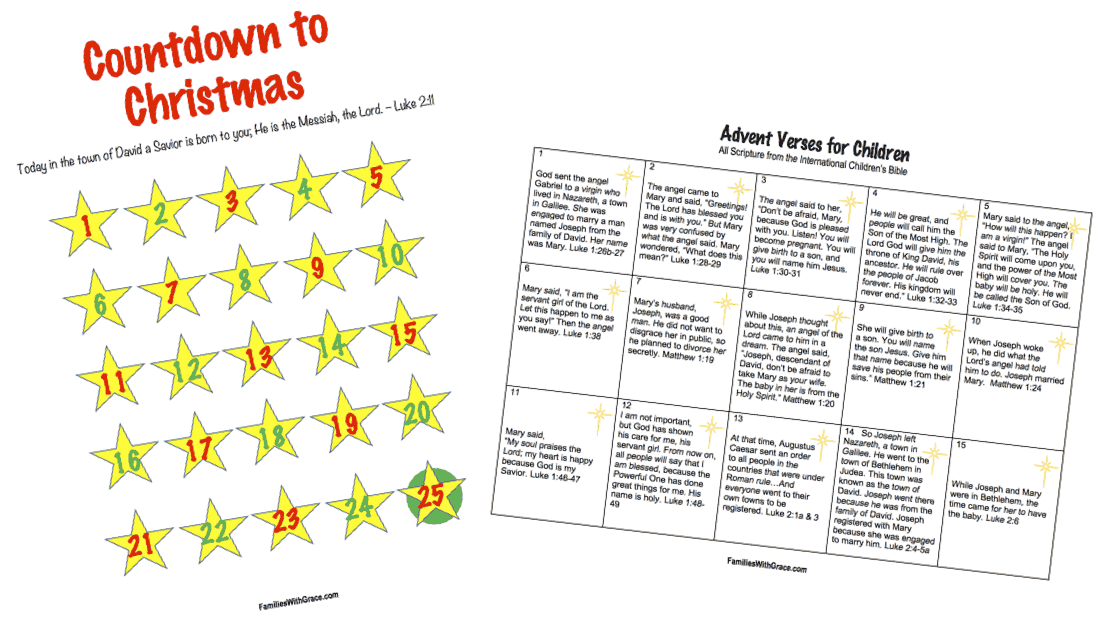
Countdown to Christmas
Though my 9-year-old understands the concept of time now, my 5-year-old doesn’t as much. He’s good with smaller amounts of time, but knowing how many days are left before Christmas is helpful for him. Plus it’s just fun to keep track together.
I have a FREE Countdown to Christmas printable that my own family uses. For each day of the month, you can put a sticker over the number or X out the number — whatever you prefer. My kiddos love stickers, so we are going the sticker route. Each number is star shaped, so hitting up the Dollar Tree for some star stickers works super well for this.
We usually do our countdown in the evening after dinner but before bedtime. We alternate which kiddo puts on the sticker each night, and then on the 25th they put it on together.
To open the PDF to download or print, click the image or click here.
Wrapped Christmas books
This is another Christmas tradition we started early on and LOVE around my house. We love books, and we really love to unwrap gifts. Thanks to programs like Scholastic book club, gifts from family and my own finds, we have enough Christmas books to last us from December 1 through 24. Now we have a few extras, but in the early days, I also included some general winter books as well. You can even use library books as long as you keep track of which are library books and need to be returned.
The week before December starts, I pull out our Christmas books and get 24 of them wrapped. It works perfectly if you have an even number of kids so they can rotate through who opens a book each night, because everyone wants to open them!
It also is great for toddlers who really want to open wrapped presents they see appearing under the Christmas tree or other places. They get a chance to open a gift! This is one we do near bedtime since we then read the book for bedtime. We combine this Christmas tradition with the next one, so each book has a Bible verse attached to it.
Daily Bible verses
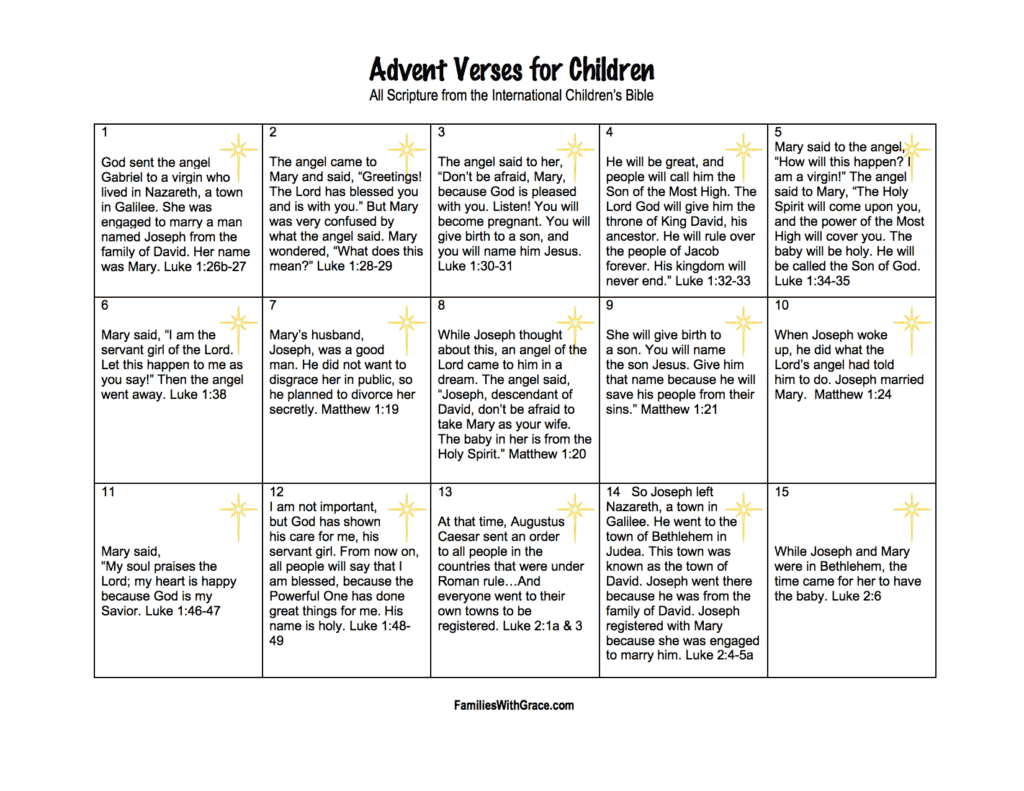
For us this works well paired with the books. I print out and cut into squares Bible verses that take us through the Christmas story, which I have for you as a FREE Advent Verses for Children printable. I fold and number each one and attach it to a book. Then the kids find the right number for the right day to open.
What I love most about this is that it makes sure every day we are taking at least a couple of minutes to talk about the real reason for the Christmas season. And each evening, before we read the verse, we review what has happened in the story up until that point. It is a great way to reiterate or teach the Christmas story to kiddos.
If you don’t do the books, you can just go through the verses on the page and mark them out as you read them. You could even cut them into squares and put them in an Advent calendar you already have. Do whatever works best for your family!
To open the PDF to download or print, click the image above or click here.
Radio ornament
Back in 2012 my parents got us this cool North Pole Countdown Christmas ornament from Hallmark. Each day starting December 1, you turn the radio dial to hear a 60-second update from the North Pole. It’s cute, funny and clever. The kids enjoy it, so we do that usually when we do the other Christmas activities, but sometimes we do it in the morning. It just depends on the day.
Christmas light tour
I love seeing Christmas lights decorating houses and so do my kiddos. As a kid, my parents would drive around and show us Christmas lights throughout the city. Even once I was an adult, my mom and I continued doing that and often included my grandmas as well. Now that I have kids, we definitely keep up this Christmas tradition. Usually we do this a couple of times throughout the Christmas season.
We will go to the more formal, organized displays and we will also just drive around places we’ve heard about where people have decorated their houses well.
For us, we keep it simple and just do it whenever we have a chance. I know some families do things like go in their PJs while sipping Thermoses of hot chocolate. That’s totally fine, too. That just doesn’t seem to work out for us (plus I’m the only member of my family who really likes hot chocolate!).
Cookie decorating party
I am the cookie baker in my family and have been since high school. I love making Christmas cookies. When my daughter was 3, I decided it would be fun to involve our families in decorating cookies with us. So one evening near Christmas, I invite over my parents and my in-laws, and we decorate sugar cookies with colored icing, candy and sprinkles. The last couple of years I’ve only made two or three dozen sugar cookies, so it doesn’t take us long. The kids have fun and our families enjoy visiting. We usually order pizza for dinner and make an evening of it.
And if you’re not a cookie baker or don’t have time, buy pre-made sugar cookie dough and roll out some shapes. You could even just make all circles to decorate with store-bought icing. It doesn’t have to be complicated to be fun!
Cookie breakfast
Like I said, I’m the cookie baker in the family. One of my favorite things to do has been on Christmas Eve morning to eat a couple of those homemade cookies for breakfast with a nice, cold glass of milk in my living room with only the Christmas tree lights on.
Once my kids were old enough, they joined me in this Christmas tradition. In fact, I didn’t give it all that much thought until my daughter was 5 or 6 and brought it up to me at the beginning of December how much she looked forward to our cookie breakfast. It was one of her favorite things about Christmas. I’ve learned that the smallest traditions can bring us together and make the best memories; this is definitely one of those traditions!
Christmas Eve PJs
My kids like to open one gift on Christmas Eve. Usually we open gifts with their grandparents on Christmas Eve and save the gifts among the four of us for Christmas morning. Regardless, they still love getting to open a gift at home on Christmas Eve before we head out.
Since I have always loved having new pajamas for Christmas (and still do!), I combined the Christmas Eve gift with new PJs, so they open new PJs on Christmas Eve. They are old enough to be onto my ploy now, so sometimes they can also convince us to pick out one more gift to open as well. They don’t tend to be as excited for new PJs as I am!
Looking for more Christmas ideas? Check out these posts!
Never want to miss any Families with Grace content? Sign up for our mailing list and receive a FREE tip sheet on 10 ways you can start living as a family with grace right now! It’s chock-full of good, practical ideas to help bring peace to your home. Don’t miss out! Go here now!
Happy World Kindness Day! Today is a day created to remind the world to be kind to each other. The focus is on making the world a better place through acts of kindness. I love that idea! It goes right along with my passion and Families with Grace.
While you’re looking for and thinking about ways to be kind to those you encounter, don’t forget about the people you encounter most: your family! Sometimes being kind to those who live under the same roof as you can be harder and take more sacrifice.
For example, buying a coffee for the car behind you at the Starbucks drive-thru is kind, but it doesn’t require much time or effort. There is minimal sacrifice involved other than the few dollars extra that you pay. (And totally do something like this if you can; it really is a kind thing to do!)
But finding ways to be kind to our families can be a little more involved. My kids, for instance, wouldn’t think twice about me paying for their food or drinks because I always do since they are 5 and 9.
I’ve come up with some ideas for you to apply to your family for World Kindness Day — and the other 364 days of the year! Give them a try, let me know what you love and share some of your ideas as well.
1. Write a note.
Maybe it’s because I’m a writer, but I love a handwritten note. Even just a few sentences on a piece of paper that say how much you love and appreciate someone can make their day. Text messages or emails work, too, if that’s more your speed or works better for your family.
2. Bake a favorite family treat.
I think my love language is food! LOL Seriously, though, there’s something about cooking or baking something special for those you love that is good for your soul. And they’ll love it, too!
Our family is big on everyone has their own chores and is responsible for their own belongings. We’re trying to teach responsibility and all that jazz, but every so often taking someone else’s dishes to the sink for them or putting their dirty socks in the hamper is just plain kind and appreciated.
4. Go around the dinner table and share things you like about each other.
My family has done this randomly a couple of times. We’ve also done it on birthdays and focused on one person. Everyone loves to hear what other people like about them. Challenge your family to say three nice things about each family member that have to be more than their appearance.
5. Ditch electronics, snuggle and chat.
What is kinder than giving someone your undivided attention? Even better, snuggle together on the couch and talk about your day. Try to do more listening than talking. The gift of being heard is priceless.
6. Banish complaints.
Decide to spend the entire day without complaining or grousing. Sometimes we get in the habit of seeing and talking about only negative things. Banish the negative and embrace the positive for a day. Your whole family can do it together or just you can do it. Either way, the shift in even one attitude can shift the attitude of the entire family.
7. Buy a small gift as a surprise.
Stop by the Dollar Tree for a small toy or trinket. Or stop by a gas station and pick up a favorite candy bar. You could even get a $5 gift card to a favorite fast food restaurant. Just find a little something your loved ones love and leave it somewhere for them to find like on their pillow, desk or usual end of the couch.
8. Join together to be kind.
Sometimes the best gift you can give your loved ones is the gift of learning to appreciate how good it feels to give. Talk about a family project you can undertake together to help someone else. Make a card together for an extended family member going through a hard time. Or go shopping for and deliver food to a local food pantry. Or bake cookies and take them to the local fire department.
9. Get crafty.
Homemade gifts can really be the best ones. I have always enjoyed cards and crafts my kids make me, but I’ll never forget how excited my daughter was when I made her a card to go with her small gift for preschool graduation because I’d forgotten to buy one. She thought it was so awesome that her mom sat down with construction paper and made one for her. It doesn’t have to be an elaborate craft (unless that’s your thing, then go for it!). Just a little something can go a long way.
10. Say thank you.
This seems too obvious, but I’m thinking of saying thank you for all the small things that we expect our families to do and don’t often comment on. Thank you husband for taking out the trash. Thank your kids for putting their clothes in the hamper. Everyone loves to be appreciated!
Never want to miss any Families with Grace content? Sign up for our mailing list and receive a FREE tip sheet on 10 ways you can start living as a family with grace right now! It’s chock-full of good, practical ideas to help bring peace to your home. Don’t miss out! Go here now!
Family game night ideas for readers and non-readers alike!
Affiliate links are used in this post, if you make a qualifying purchase via my link, I receive a small percentage of the sale at no additional cost to you. I only recommend products and services I use and love. It helps support my blog, so thank you for your support! Read my full disclosure here.
Family game night is one of our favorite activities around my house. Sometimes, however, it can be challenging to find games that all four of us like. Since our youngest kiddo is just in kindergarten and an early reader, we have to find games that don’t require much reading. Finding those games that are also fun for my husband and me along with our 9-year-old can be a challenge. While Candyland, for example, is a fun game with a little one, it quickly grows boring for older children and adults.
But we have found a few games that work well for all four of us. These are games that require either no reading or minimal reading and are actually fun. Even better, all of them are under $20! In fact, only two are above $10 and the last two are less than $5. Go ahead, pop some popcorn and prepare for a fun family game night for all ages!
My son received this game from a friend for his 5th birthday. We weren’t sure if it would be too messy or what we would think about it, but my kids fell in love with it. In fact, when I told them I was writing about our favorite family games, this is the first one they both named! It’s a simple game where you spin a roll of toilet paper to see how many times you have to flush a toilet that is filled with water. At random times the flush will make water squirt out of the toilet, in which case the player is eliminated. The last player standing is the winner. It’s completely random and not skill based, so age and experience really don’t matter one bit.
I suggest keeping a dish towel on hand to wipe off the spills that happen sometimes as little ones excitedly pass the toilet back and forth and wipe faces when they get sprayed, but it isn’t too messy to play inside or even at a dining room table that has carpet underneath. Our whole family has enjoyed this game, including my parents who have played it with us as well. My mom got such a kick out of it with my kids that she purchased it for my brother’s kids, too!
This one is fun and simple. It could be played almost anywhere. In fact, this is one that we tend to play in the living room. Each player gets a couple of six-sided dice that have different images on each side. At the beginning of a round, everyone rolls their dice. The first person begins a story based around one of the images they rolled. We usually start with the youngest and then rotate who starts the story from there. Each person builds on the story based on their images on the dice.
The nice thing with this game is that it’s fun (and can get silly!) but doesn’t have a winner. It’s a cooperative effort for the whole family. It’s one of those games where you never have to try and soothe the hurt feeling of a loser, because there are no losers!
This is based off of the television show. This one works better if you have a few more players, but you can play it with four players. If it’s just the four of us, we play more often cooperatively. But when we played it with my parents a few months ago, we teamed up three to a team. It does require a bit of reading, but it wasn’t an issue to my son. Since we were on teams, we helped him with the words and then he was able to come up with some good answers for the questions.
This one is a classic, but it really is still a hit with my family. I will say that my husband and I tire of this one before the kids do, but we get in a few good rounds with it and play some variations sometimes. There is one yellow ball for the hippos to eat and the rest are red. One version is that whoever gets the yellow ball wins, but that doesn’t go over quite so well with my kiddos. We have modified it so that the yellow ball is just worth 2 points instead of one. We also take turns on who gets to say “Go!” on this one to help keep it fair.
While you can play Go Fish with a regular deck of cards, there are all sorts of variations that make it more fun for little ones. Years ago, we found a version that was dinosaurs that my kids have enjoyed, but there are so many versions for whatever your family enjoys!
In May of 2016, our beloved family dog had to be put to sleep after a short battle with an aggressive cancer that couldn’t be treated. In May of 2017, my last remaining grandparent — my maternal grandmother — passed away after a few months battling varying issues. A couple of days ago, my uncle died after dealing with kidney cancer over the last year. While cancer makes you think we’d be prepared, we weren’t. His treatment had actually gone well overall. When complications started a couple of weeks ago, even those seemed to be resolved. Until overnight everything changed and within 12 hours, he was in heaven.
Dealing with these loses has been difficult. Each time, in the midst of my own grief, one of my first thoughts has been, “How are we going to tell the kids?” Because grief with kiddos is hard, and they were very close to each of these loved ones. I want to protect them and shelter them from every hurt that can happen in this imperfect world. I want to make it all better for them. Yet, that isn’t one bit how it works. I know there are articles and books written on grief with kids. I know there are actual experts on the topic. I am certainly not, but I do know what dealing with grief looks like in our family. And from that experience, I offer some thoughts.
Give yourself time to process the loss. I have found it’s important to not tell my children until I’m ready to have a conversation without sobbing. My husband and I need time to process the loss first before we can talk to them. This has happened in various amounts of time based on the situation. But usually, it has been within 12 to 24 hours.
Use the right words. Once we are ready to talk, then we sit down together as a family without distractions and try to be as straightforward as possible using words like “die” and “death,” so they understand what we mean. Little kids, especially, don’t understand or know euphemisms such as “passed away.”
Talk about heaven. We talk about how our loved ones, especially in each of their situations, are no longer in pain. We talk about how they can run free. As the losses have continued to accumulate, we even talk about our loved ones interacting in heaven. We talk about how good it is for them there. We talk about how we can be happy for them but sad for us and that is OK.
Discuss different reactions and emotions. My son is the youngest of our family. He was 3 when our dog died, 4 when my grandma died and now is 5. He processes things very matter-of-factly and doesn’t quite get all the feelings right away. My daughter was 6, 7 and 9 during these losses and understands them differently. She immediately tears up. We talk about how it’s OK to cry and it’s OK to not cry. We talk about how sometimes we feel like crying when it surprises us or sometimes we don’t cry when we think we would. There is no wrong way to have feelings during losing a loved one. Sometimes sadness comes out in tears and sometimes in other ways. My older brother, for example, was almost 4 when our paternal grandpa died and my mom said his first reaction was anger. And that’s OK, too.
Let kids see your emotions. I don’t often cry in front of my children. I have times of getting teary or choked up, but outside of these losses, I’ve not really cried in front of them. I think it’s important for them to see my tears and be reassured that any sadness they are feeling is OK and they aren’t alone. My husband usually displays his sadness without as many tears, because that’s more his nature and that’s OK, too.
Let them ask questions. After we give them the information, talk about heaven and emotions, we also make sure to ask if they have questions. I have been surprised sometimes at where their minds go and the things they wonder about. We are also honest when they ask questions that we don’t know like “Why did God want them in heaven now?”
We also reassure them that if they think of questions later or just want to talk about it or whatever, they are free to come to us any time. And we keep that open. It has pierced my heart a couple of times as they have brought up things later on that brings that grief coming back fresh, but I want them to have the freedom they need to process it in whatever amount of time it takes them or in whatever way they need to.
Address their fears. Sometimes our kids have brought fears up, but sometimes we have brought them up first. For example, we are quick to remind them that the kind of sickness our loved ones had was more than just a regular sickness and they don’t have anything to worry about if one of us gets sick with a cold or virus. Since I’ve had a few surgeries in these last few years, we are also careful about correlating a surgical procedure to death. It’s a pretty quick and easy leap for kiddos to start thinking sickness or surgery equal death.
Follow their lead. Kids are so very resilient. Each time we have dealt with a loss, I am amazed at how quickly they shift gears from being sad to wanting to do something else. While my husband and I still need to deal with our grief in different ways, we do our best to move on with them to another activity. We have learned to plan something as a distraction each time that we can offer to get everyone shifting gears, even if it’s just going out to dinner.
Talk about ways to be proactive. We try to also talk about how grief is hard. We don’t diminish that, because grief is really stinking hard. But we also assure them that we will get through this and it will get easier. And we talk about something we can do. For example, when my grandma died, we talked about how my mom and aunt would be feeling sad and maybe the kids could give them extra hugs. This week we’ve talked about coloring pictures and making sweet treats for my aunt to remind her that she isn’t alone.
Don’t push; just bethere. While I have been surprised by my kids’ resilience and ability to shift gears, I have also been surprised at various times they bring up the loss and how they are sad. It pops out at odd times sometimes, just like it does for grown-ups. While my daughter has been older and tended to cry a bit with the information, she has moved on pretty well during the day. But then bedtime comes and she tends to struggle more. Last night, she crept back downstairs and was feeling very sad. So we just sat snuggled on the couch for a while, neither one of us talking. Sometimes sitting together in silence is the best. And then I gently helped her think of some other things to help her be able to move forward into going to sleep.
Know when they need grace. This one can be a bit tricky to assess sometimes, but my kids get extra grace for their behavior and words when we are dealing with a loss. I need extra grace for my behavior and words. I know I’m not at my best and that sometimes I get grumpier much more than I would usually. I don’t expect them to be any different. So sometimes when they do something that would usually merit a strict punishment, they get off lighter or get a reminder that isn’t how we are supposed to behave. If it keeps happening, especially in one day, we stop and ask them questions about how they’re feeling. They don’t get carte blanche permission to do whatever they want to without consequence, but they do definitely get some grace along the way.
Losing a loved one hurts. Each time, I have wished I could take the hurt away from my children and told them as much. But we’ve also talked about how it hurts because we had so much love, and love is a good thing. We have talked about good memories and how we’ll always have those memories. We have mourned together and even found some laughter in the midst of mourning. I really do wish I could take the grief for them, but I also want to do my best to prepare them for loss since hurt and grief is a part of the world.
I don’t have all the answers and am not an expert at dealing with grief myself. Sometimes I’m good at distracting myself and pretending if I don’t think about it that it will go away. (That never works, by the way.) But I have learned more and more through the years that sometimes I have to just let myself feel all the feels and be broken down in order to start healing. I have shared that with my children to an extent according to their ages. I have also learned, though, that no matter how hard and painful this stuff is that God is always there. He is always ready to comfort me. He hears me when I get a phone call with news and can only pray “Jesus” over and over because my heart is broken. In the end, as always, Jesus remains the answer to grief whether it’s my own or my children’s. I pray that they realize that and see me living that out, in spite of the times when I mess up.
About two years ago, a friend of mine shared a prayer for parents on social media. I really liked it, and I have been using it ever since. I’ve been curious about its origins, so I did a bit of research and found that a version of the prayer first ran in the Dear Abby column in 1971. A slightly revised version ran again in 1980.
But it has evolved a bit and changed. I have tweaked it ever so slightly and now have this version that I pray regularly. I am a big fan of a prayer app. I know it sounds weird. It sounded weird to me, too, but then I tried it and fell in love with it. The one I use and love is called PrayerMate, which is available for free both Apple and Android users.
Basically, I utilize my prayer app for Biblical-based or pre-written prayers, like this parent’s prayer, as well as to organize requests from friends that I may forget to add into my daily conversations with God. I end up actually praying more for requests this way than I did before. And I have found I can also relax in my talks with God because I don’t have to try to scramble and remember ongoing prayers and prayer requests. I know my app will rotate through them.
I have also been blessed by God’s timing when a request comes up in my prayer app for a person or situation in the morning and then later that day I find out the person or situation has really needed extra prayer that day. I see that as more than a coincidence — it’s a God thing!
I also have my app set to remind me every morning to spend some extra time in prayer after my kids are off to school. I utilize it during my usual Bible and prayer time as well. It just comes in handy. You can set as many or as few subjects as you want. The app offers prayers to pick from as well. I’m sure there are other prayer apps that work well, too.
Of all the prayers I’ve come across, this parent’s prayer is one of my favorites. It reminds me so very much of my job and responsibility as a parent. It reminds me of what is important in parenthood. It reminds me to place all of it at God’s feet so that I can be a better parent to my children with His strength and direction. I’ve made it into a free printable for you to download, so you can join me in this prayer for our parenthood journey as well. Just click the image below!