Families With Grace

Helping Christian moms create homes filled with grace, love & faith

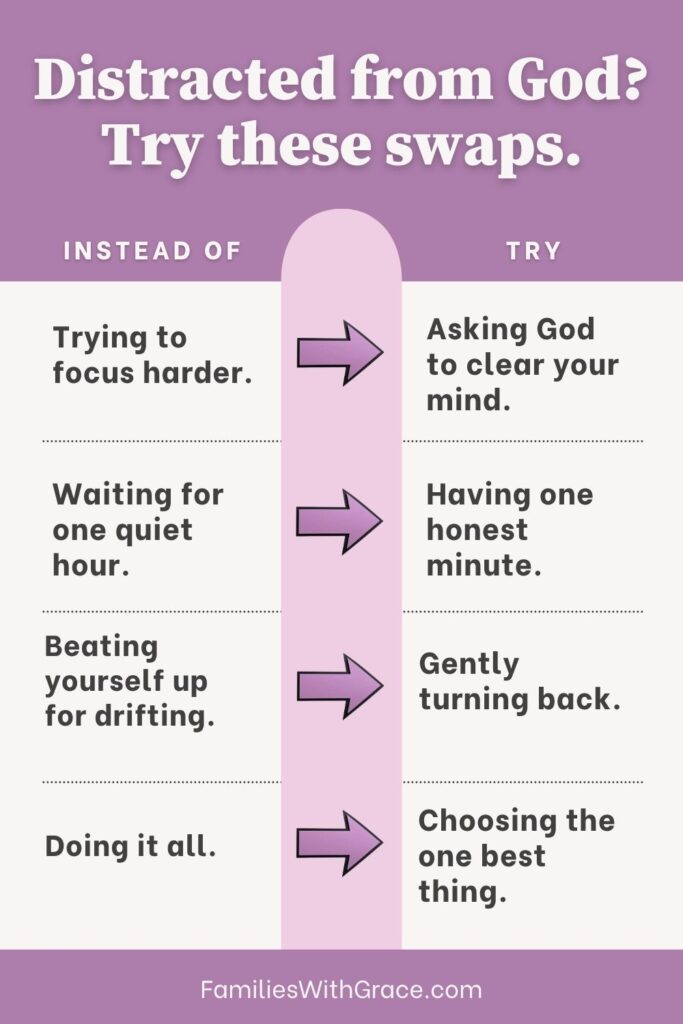
How to stay focused on God as a busy mom

Simple, low-pressure ways to clear the noise and refocus your heart when life gets loud

I sat down to be with Bible yesterday morning with every good intention to stay focused on God for the next 20 minutes.

And then my husband had a question for me. I remembered a phone call I needed to make and paused to write it down. My daughter stopped by to ask me about a new medicine she’s starting.

That’s just the external stuff. There was still everything in my brain going a mile a minute about what all needed to be don that day and how behind I was.

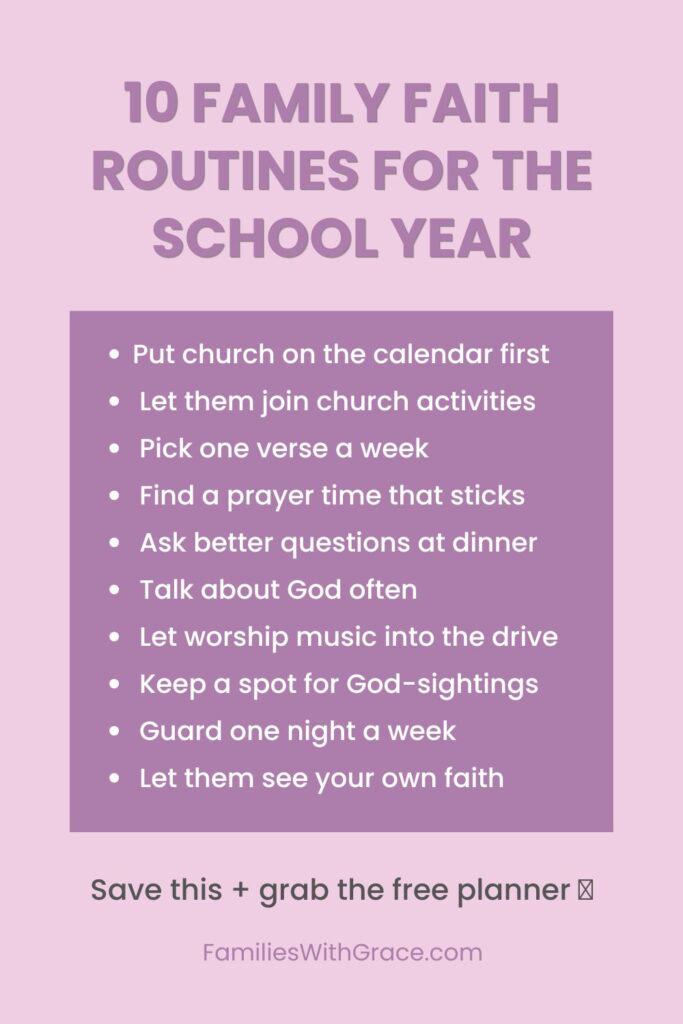
How to stay focused on God as a busy Christian mom Pinterest image 1

If you know that feeling, you are in good company. Staying focused on God is one of the hardest things to do in a full season of motherhood, and it has almost nothing to do with how much you love Him.

It has to do with noise.

Why focus feels so hard right now

Our attention is the most fought-over thing we own. Phones, notifications, mental to-do lists, other people’s opinions, the low hum of everything we think we should be doing.

None of it is evil on its own. It is just loud, and loud crowds out quiet.

August makes it louder. Schedules shift, school ramps back up and the calendar fills before we’ve had a chance to catch our breath. It’s the exact season when our focus on God tends to slip without us even noticing.

Here’s the reframe that helps me: staying focused on God was never meant to be one more thing to be good at.

Scripture doesn’t ask us to earn a perfect attention span. It invites us to keep coming back.

“Let us throw off everything that hinders and the sin that so easily entangles. And let us run with perseverance the race marked out for us, fixing our eyes on Jesus.”

Hebrews 12:1-2 (NIV)

Throw off what hinders. Fix our eyes.

That’s the whole picture: clear some noise, then look His way. Not perfectly. Just honestly.

Simple ways to refocus your heart on God

You don’t need a silent house or an hour to yourself. You need a few small, repeatable ways to come back to Him in the middle of an ordinary day.

1. Name the noise.

You can’t quiet what you won’t look at. Take one minute and jot down what’s actually pulling your attention right now, whether it’s a worry, a task or a screen you keep reaching for.

Getting it out of your head and onto paper is a small act of setting it down.

For example, my pause to write down a reminder to make a phone call was distracting in the moment, but helped me get that out of my mind and out of the way so I had da better chance to stay focused on God.

2. Pick one thing, not 10.

When everything feels important, focus scatters. The prayer for this season is Psalm 86:11 (NIV):

“Give me an undivided heart.”

Choose one verse to sit with, or one small way to notice God today. (Try our free “Simple Spiritual Focus” Bible reading plan to help you do just this with one or two verses each day.)

One is enough. One you’ll actually do beats 10 you feel guilty about.

3. Give your focus a home.

Attention likes a routine — and so do I! Pick one everyday moment that already happens, like the first minute after your feet hit the floor or the pause in the school pickup line, and let it be your regular check-in with God.

I have some of my best prayer time where I stay focused on God when I’m in the shower.

Same time, same trigger, no pressure. A verse on the bathroom mirror does more than a plan you can’t keep.

How to stay focused on God as a busy Christian mom Pinterest image 7

4. Come back gently.

Your mind will wander. That is not failure, it’s being human.

The practice isn’t never getting distracted. It’s noticing and turning back without the guilt spiral.

Every gentle return is the point, not the interruption. Sometimes the simplest way to stay focused on God when your attention wanders is to ask for His help or simply say, “Jesus.”

5. Let some things go.

Focus is a choice about what matters most, which means some things don’t make the cut.

You are allowed to let a few good things fall away this month so the most important One doesn’t.

Choosing God’s presence over a fuller to-do list is not falling behind. It’s refocusing.

When you lose focus again

I know you’ll lose focus again simply because I certainly do. Our mama lives and brains are filled to the brim!

The good news buried in all of this is that God’s attention on you never wavers, even on the mornings yours does.

He isn’t tapping His foot waiting for you to concentrate better. He is already here, in the loud and the ordinary, glad to have you back the second you turn His way.

He is so full of love and grace for you that He’s never as disappointed in you as you are yourself.

Spiritual focus is less about trying harder and more about returning often. That’s something even the busiest, most distracted mom can do.

A simple way to start

If you want a gentle, low-pressure way to keep your eyes on God this month, I put together a free Simple Spiritual Focus Bible reading plan. It’s one short verse a day, built around clearing the noise and refocusing your heart, and it’s made to fit real life, not add to it.

And if you’d like to walk through it alongside other moms who get it, come join us in the free Christian Moms with Grace Facebook group. We’re doing this one together.

We go even deeper into Bible study and conversation in our membership group, The Grace Circle for Moms. We’d love to have you join us!

Looking for more? Check out these related posts:

How to connect with God in everyday life as a busy mom

10 Short prayers for your day (Simple ways to talk to God)

How to see God in everyday life and feel closer to Him

Taking a break from your kids: Why it’s OK to need one

A Christian mom’s honest take on the guilt that says good moms don’t need time away — and how to actually get the break.

I’ll never forget the day my husband came home from work early when our son was 7 months old and our daughter was 3. He walked in the door to find the dog barking, me cleaning spilled milk off a crying 3-year-old and the baby boy crawling around with a runny nose.

He wryly said, “This isn’t what I expected to come home to.”

In the middle of chaos, I quickly responded, “Then you must have thought you were coming home to a different house.”

The truth behind the chaos that day was that I was exhausted and overwhelmed. Yet, it was also just a regular day in parenthood at that stage.

I was so grateful he walked through the door and could pitch in for even a few minutes to give me a break from the kids, because I desperately needed one.

Taking a break from your kids Pinterest image 3

There is a particular kind of tired that has nothing to do with sleep. It’s the worn-down feeling of being needed all day, by everyone, with no pause.

And underneath it, a quieter thought we hate to say out loud: I need a break from my kids.

For a lot of us, that thought shows up with a wave of guilt close behind. We love our children fiercely. So wanting time away from them can feel like a betrayal.

I want to say this gently and clearly. Needing a break does not mean we love our kids any less. It means we are human beings, not machines.

Why needing a break from our kids feels like failing

Somewhere along the way, we picked up the idea that a good mom is always available, patient, present and happy to be climbed on.

So when we hit our limit, it feels like proof that we are doing it wrong. Somehow the limit itself seems like the failure.

That pressure is everywhere. It’s in the highlight reels online, where everyone else seems to have endless energy and a sunny attitude.

The guilt gets even louder when the help we need is with the kids themselves. Asking someone to watch them so we can leave can feel like admitting we cannot handle our own children.

When my kiddos were 2 and 5, I was contemplating taking a low-impact workout class led by a friend. I really struggled with the decision.

I was blessed to have a husband to take charge and both sets of grandparents in town and available. I’d left the kids before for a work meeting or a date with my husband. But I’d never left them to do something just for me.

I was plagued by guilt about whether it was OK for me to take a break to do something solely for myself.

But that guilt was built on a lie. The lie says our worth as moms is measured by how much we can pour out without ever refilling.

That is not how God made us. And it is not how He made our kids, either.

Needing a break doesn’t make you a bad mom

Here is the truth we have to keep relearning. Rest is not a reward we earn after we have given every last drop. It is part of how we keep going.

A mom running on empty cannot pour out what she does not have. That slow slide toward mom burnout is real. We all know the version of ourselves that shows up after too many days with no margin.

She is shorter-tempered. She is quicker to snap and slower to laugh.

Stepping away for a bit is not abandoning our kids. Often it is the very thing that lets us come back as the mom we actually want to be.

There is even a quiet gift in it for them. When our kids see us practice self-care, they learn that they are allowed to do the same one day.

The relief we feel when we finally get a break is not a red flag. It is our bodies and spirits telling us the truth about what we need.

Taking a break from your kids looks different in every season of motherhood

When the kids are tiny, a break can feel almost impossible. Someone always has to be watching them, and the watching never stops.

In those years, a break might be 20 minutes while a neighbor walks the stroller, or having your husband take the early shift so you can sleep in. It is small, but it is everything.

In the middle years, roughly ages 6 to 11, my best break often came after bedtime. My husband and I could watch a show together or read, knowing we had that quiet stretch each evening to look forward to.

Some nights it had to go to chores. But we protected it as downtime as often as we could.

I also learned to slip away for 30 minutes alone in my bedroom while my husband was on duty or the kids were happily occupied. I’d read a few pages or take a short nap, and it reset me.

As kids grow into the teen years, the breaks change shape again, but the need does not disappear. The mental load of motherhood follows us right in.

Life has certainly changed for us from those early days. Now with a 13- and 16-year-old, the chaos is different as we’re working to figure out just the right amount of independence. We’re managing driving, braces, work schedules, activities and so much more.

We’ve also lost that after-bedtime window, because their bedtimes are now the same as ours, and on weekends and school breaks they often stay up later than we do. So we have to find the break in other places.

These days, a little me time often looks like the quiet before everyone wakes up, or driving somewhere alone and belting out praise music in the car. Sometimes it’s waiting in the car while a kid is at an activity, or simply telling my kids and husband I need a nap and taking one.

Other times it looks like telling everyone that dinner is DIY because figuring out cooking and cleaning up afterward is just too much for the day.

Wherever you are, the season you are in does not decide whether you deserve a break. You always do.

Even Jesus stepped away

If anyone ever had a reason to keep going without stopping, it was Jesus. The crowds were endless. The needs never let up.

And yet Scripture tells us this:

“But Jesus often withdrew to lonely places and prayed.”

Luke 5:16 (NIV)

Notice that word “often.” This was not a one-time collapse. It was a rhythm — a regular stepping away to pray and be restored.

If the Son of God built breaks into His life on purpose, surely we can let ourselves off the hook for needing them, too. Pulling away to refill is not selfish. It is wise, and it is good.

There is a spiritual reason to guard these breaks, too. It is hard to connect with God when we cannot finish a single thought, let alone a whole prayer, without being interrupted.

Stepping away for a few quiet minutes gives us room to actually meet with Him. And that time with God is often what refills us enough to keep going.

The honest part: a break has to be planned

Here is what nobody tells us. “Just take a break” is easy to say and hard to do.

Most of us do not have a built-in village standing by. Childcare is expensive and hard to arrange, and the people who could help have full lives of their own.

So a real break rarely just happens. We usually have to plan it on purpose, and that means asking.

In the early days of parenting, sometimes that meant asking my husband to take over so I could enjoy a long shower. Other times it meant asking my parents or in-laws to watch the kiddos.

The good news is that a break does not have to be big or expensive to count. A couple of quiet hours can reset a whole week.

How to actually get a break from your kids

Knowing we need a break is one thing. Making it happen is another. A few things can help.

Ask your husband for a specific block of time

“I need a break” is too vague to act on. “Can you take the kids Saturday from 9 to 11 so I can get out of the house?” gives him something concrete to say yes to.

Be clear that you mean a real break, not you in the next room still on call. The whole point is to actually step away.

My husband has a standing Monday evening online gaming session with some of his close friends. He’s carved out that block of time weekly.

I’ve been thinking about what I can do in the same vein, even once a month.

Not every mom has a husband or partner to hand off to, and even when we do, he isn’t always within reach. If that describes you, the ideas that follow do not lean on a spouse at all.

Trade with another mom

If a sitter is not in the budget, a swap costs nothing. Maybe you take her kids Tuesday morning, and she takes yours Thursday.

You both get a guaranteed break, and the kids get a playdate out of the deal.

Lean on the family you have

Many of the people in our lives would gladly take the kids for an afternoon if we let go of our pride and simply asked. Think about grandparents, a sister, an aunt or a trusted friend.

People often want to help. They are just waiting to be asked.

Don’t forget about church family as well. Our small group, for example, has been supportive of us. One couple recently had our son over to do chores when they heard he was looking for ways to earn money for a school trip.

Use your church’s nursery or kids’ ministry

If your church has a nursery or children’s program, let yourself use it. Handing the kids off for the service is not a cop-out.

It lets us focus on the message, grow in our own faith and catch a genuine breather all at once. That time with God can be the very thing that gives us strength for the week ahead.

Build in a daily quiet time

After kids give up naps, the day can feel like it has no bottom to it. My oldest gave up her nap while I was pregnant and exhausted with her brother, so I traded naptime for quiet time.

She stayed in her room for an agreed-upon stretch, 30 to 60 minutes depending on the day, and could play, look at books or rest. Some afternoons our quiet time looked like snuggling together to watch “Mickey Mouse Clubhouse” while I closed my eyes.

A daily pocket of quiet like that is a break we can build right into the rhythm of the day, no sitter required.

Start small and protect it

If a whole morning feels impossible, start with 30 minutes. Take a walk around the block. Enjoy a cup of coffee you get to drink while it is still hot. Find a small way to do something for yourself.

Then guard that time. When the guilt creeps in, remind yourself that this is not stealing from your family. It is keeping you steady for them.

A spiritually, physically and mentally rested mama is a happier mama.

Sometimes a break just means breaking the monotony

Here is something it took me a while to learn: a break is not always about getting away from our kids. Sometimes it is just about getting out of the sameness.

Taking a break from your kids Pinterest image 8

When my kids were little, our weekly library story time was a lifeline. It was built for the kids and they loved it, but for once I was not the one in charge.

It got us out of the house and doing something different. I got to connect with other moms in the same season, my kids practiced being around others and afterward we explored the children’s section and played with toys that felt brand new to them.

A reset can be that simple. It might be a video call with grandparents or a friend, even one who lives across town. It might be a new show watched together, or the kids in the bath with a pile of toys while we sit close by and breathe.

Sometimes the break even hides inside something ordinary. Running to the grocery store alone can feel like a small vacation. I’ve eaten lunch by myself in the car after a drive-thru run and felt completely refilled.

None of that requires childcare or extra dollars. It just asks us to let a change of pace count as the break it really is.

You don’t have to earn rest, mama

I still have to preach this one to myself. The guilt does not vanish just because we know better.

But we can choose to step away anyway. We can choose to believe our needs matter too, because they do.

“He makes me lie down in green pastures, he leads me beside quiet waters, he refreshes my soul.”

Psalm 23:2-3a (NIV)

That refreshing is not a perk for the moms who have it all together. It is an invitation for the tired ones, which is all of us some days.

So take the break. Ask for the help with the kids. Let someone else hold things for an hour so you can breathe.

You are not a worse mom for needing it. You are a wise one for taking it.

And sometimes what we need isn’t a break from the kids at all. Sometimes we just need help with everything else: the dishes, the laundry, the never-ending list. If that’s the kind of help you’re after, here’s Asking for help as a mom, which has great ideas for getting help with your to-do list.

And once the break is won, How to rest as a busy mom is right here for when you are ready to rest. You are always welcome in our Christian Moms with Grace free Facebook community, too.

Asking for help as a mom: Why it’s OK to stop doing it all

Letting go of the guilt, pride and perfectionism — and learning how to actually ask for the help we need.

The vacuum is running upstairs. I can smell the cleaning spray drifting out of the kitchen. And I haven’t lifted a finger to do any of it.

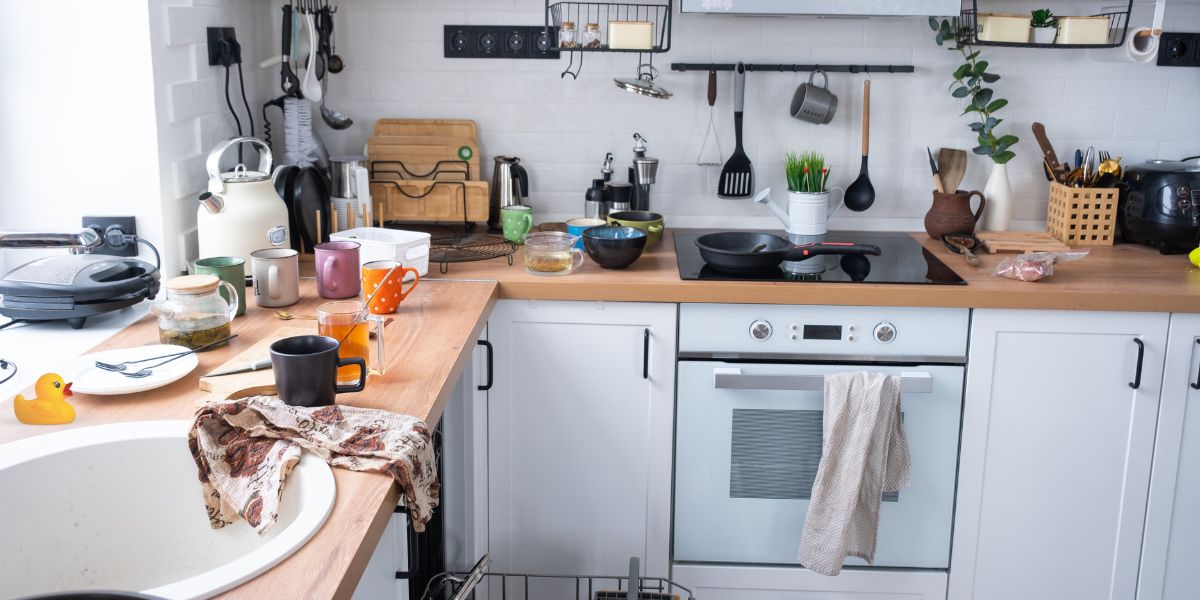
For a long time, that sentence would have made me cringe with shame. Just the other day, I looked at our out-of-the-way kitchen countertop piled with all sorts of things, sighed and went to sit with my heating pad for a while.

Somewhere along the way, most of us picked up the idea that a good mom does it all herself. So when we can’t, it feels less like a season and more like a verdict.

How to ask for help as a mom Pinterest image 1

I want to gently push back on that, because I’ve lived on both sides of it. Asking for help isn’t a sign that we’re failing. Most of the time it’s a sign that we’re paying attention.

Why asking for help feels so hard

Asking for help goes against our pride and our deep wish to be independent and strong. We don’t want to admit we can’t do it all. We’d rather carry the whole weight, plaster on a smile and stumble around under it than say the words out loud: I need help.

For me, it has always been tangled up with the house. Early in our marriage, I realized I felt the most responsible for how our home looked to other people.

When things were in disarray — and they were, more often than not — I took it as a personal failure. Add two kids and some real health challenges, and that quiet shame had plenty to feed on.

It helps to name where that pressure actually comes from, because it isn’t from God. It’s from comparison, from the highlight reels, from an old story that says needing anything makes us less.

None of that is true. We were never built to do this alone.

Laying down the guilt

So much of this is guilt, and it runs deeper than we admit. As women, we’re often conditioned to believe we should do everything ourselves. We worry that asking makes us look weak.

And the guilt gets sharpest right where it should be softest: with our own families. Asking our kids or our husband for help can feel like proof that we’re failing at the one job we’re sure is ours alone.

We tell ourselves all kinds of things. That asking our kids to pitch in is stealing something from their childhood. That asking our husband one more time makes us a nag. That a good mom would just handle it.

We need to lay that guilt down, because most of it isn’t even true. Our kids don’t need a mom who does everything for them. They need to learn responsibility in age-appropriate ways, and a reasonable chore is a gift to their future, not a theft from their present.

And our husbands are not better off when we swallow the need and quietly stew. Resentment built up in silence does far more damage to a marriage than a clear, kind request ever could.

Asking isn’t nagging. Asking is letting the people who love us actually love us back.

I learned this the hard way

About 13 years ago, my mom and my mother-in-law came to my house nearly every day while I recovered from surgery. I had a preschooler and a baby, and I couldn’t lift the baby for six weeks.

The months leading up to that surgery had been brutal: three months “sleeping” in a recliner, shingles, two rounds of stomach flu, strep throat. My head was barely above water.

While they came to help with the kids, they also saw the drowning need at my house. I still remember them scrubbing my bathroom and my kitchen, and the wave of relief and gratitude I felt that those simple things were getting done, even though I couldn’t do them myself.

I mentioned it to a group of mom friends online. One of the first comments said she could never imagine letting someone else clean her bathroom. Ouch. She didn’t seem to understand that I had no other choice. I literally couldn’t do it.

My husband was holding all of us together and working full-time in another city. He couldn’t do it either. So I learned, slowly and reluctantly, to let go of my pride and ask.

These days the reason is named: fibromyalgia. My back, my hands, my arms — everything, really — has limited use on any given day. I work in small spurts to avoid tipping into a full flare.

I could start every deep-cleaning task in spring and still be at it in fall. So I made peace with a hard truth: I can’t do all of it, and pretending otherwise only hurts me.

Help looks different in every season

Here’s what I wish someone had told me sooner: help is not one thing, and it does not require money.

Some of mine is paid. Once a month, someone comes to do the deep scrubbing my body can’t manage anymore — the tubs, the floors, the baseboards. I’ll be honest, that took me a while to share, partly because I didn’t want anyone to think I have piles of disposable income (I don’t) or a full-time housekeeper (I don’t).

The everyday house cleaning tips I share are still the everyday things I really do. It’s the hard-core scrubbing I’ve had to hand off.

But most of my help costs nothing. My kids are 13 and 16 now, and they are fully capable of carrying their share. The catch is that they don’t see what I see.

A basket of laundry outside the laundry room is invisible to them until I say, clearly, “Please fold this laundry and put it away.”

Same with my husband. I’ve stopped waiting for people to notice and started asking them directly and specifically. That one shift changed more than any cleaning hack ever did.

And help can come from further out, too. Maybe you have a friend you trade childcare with, a neighbor who grabs something from the store, your people at church or the mom at school pickup who’s just as buried as you are. None of that requires a budget. It requires us to open our mouths and ask.

What God says about carrying the load

There’s a spiritual layer here that’s easy to miss. He never designed us to carry the weight of the world. He designed us to let Him carry it, and to let each other share it.

When Paul pleaded with God to remove a burden, the answer he got wasn’t relief, it was this: “But he said to me, ‘My grace is sufficient for you, for my power is made perfect in weakness'” (2 Corinthians 12:9, NIV).

Then Paul says something that still stops me: “For when I am weak, then I am strong” (2 Corinthians 12:10, NIV). Our limits aren’t the opposite of God’s strength. They’re the very place it shows up.

We also weren’t meant to do faith, or motherhood, alone.

“Carry each other’s burdens, and in this way you will fulfill the law of Christ.”

Galatians 6:2, NIV

Notice that carrying each other is the whole point. When we let someone help us, we’re not failing the assignment. We’re living it out, and we’re giving them the gift of being needed.

How to actually ask for help

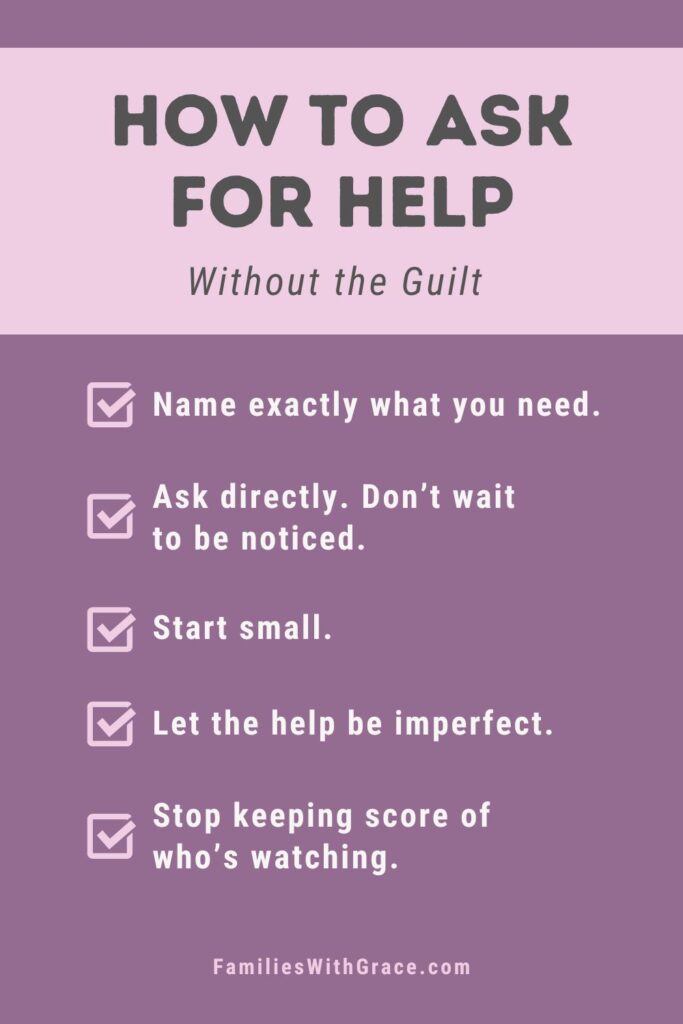
Knowing it’s OK to ask is one thing. Doing it is another. A few things that have made it easier for me, and might for you too:

Name what you actually need.

“I need help” is too big to act on. “Could you handle bath time tonight?” or “Will you put away this laundry?” gives the other person something they can say yes to.

If I complain to my family that the house is a mess, not much gets done. If I ask for specific chores to be completed, then they do get done.

How to ask for help as a mom Pinterest image 7

Ask directly — don’t wait to be noticed.

Our people aren’t ignoring us on purpose. They genuinely don’t see the mental list running in our heads. Saying it out loud isn’t nagging. It’s communicating.

I learned early on in marriage that my husband isn’t a mind reader. If I have a need, then it’s up to me to voice it.

Start small.

If asking feels impossible, pick one tiny thing this week and ask for it. Confidence grows from there.

You could start with something as simple as asking a friend to pray for a specific need you have this week.

Let the help be imperfect.

The towels may get folded wrong. The dishwasher may get loaded in a way that makes you twitch. Let it go. Done by someone else beats undone by no one.

My husband and kids fold towels differently than I do, so they don’t stack perfectly in our closets. I’ve learned to let it go, because after all, the towels are still clean, still folded and still put away. That’s what matters most.

Stop keeping score of who’s watching.

Anyone who would judge you for needing help isn’t carrying your load, and probably isn’t paying attention to the right things anyway.

Instead, think of how you’d react if the person you’re asking to help you asked you for a favor. Chances are really good you’d be happy to help. Assume the same of those around you.

You don’t have to do it all, mama

I still don’t love needing help. I’d rather be able to do it all myself.

But I’ve learned that my real options are to ask for help, hurt myself trying to do everything or leave it undone and stew about it.

So I choose to ask. I choose to release the things I can’t do and be thankful for the things I can.

Wherever you are, I’d bet there’s something you could use a hand with — and that’s not weakness. It’s just being human, which is exactly how He made us.

So this week, let go of one thing and ask. You don’t have to carry it all, and you were never supposed to.

And if what you really need isn’t help with the tasks but time away from the kids themselves, we’ll talk about that soon.

And sometimes the help we need isn’t with the dishes or the laundry at all. Sometimes we need a break from the kids themselves, and that’s its own kind of OK. If that’s where you are today, here’s Taking a break from your kids.

If you’re in a tired season, you might also like How to rest as a busy mom and this short devotional, A truth every stressed and overwhelmed mom needs to hear. And if you just need other moms who get it, you’re always welcome in our Moms with Grace community.

How to rest as a busy mom: 7 Practical ways to actually make it happen

We’re told to rest, but rarely how. Here’s how to find real rest as a busy mom.

Ask a mom of little ones how she finds time to rest and she’ll probably laugh, then maybe tear up a little. I remember those days in the thick of it — babies and toddlers needing something every single minute, the kind of tired that sleep didn’t touch.

How to rest as a busy mom Pinterest image 1

My kids are teens now, and I still have to fight for rest. The laundry never stops. The dishes multiply by the hour. Somebody always needs a snack, a ride or a permission slip that was due five minutes ago.

We hear it all the time: we should rest. Take a Sabbath. Slow down. Fill our own cup first. It’s good advice. But almost nobody tells us how to actually do it when there’s a toddler on our hip and a to-do list that resets itself every morning.

And so rest becomes one more thing we feel behind on and one more way we’re falling short. We tell ourselves we’ll rest when the house is clean, when the kids are older, when life calms down. But that day never quite arrives.

So let’s talk about the part nobody covers: not why rest matters, but how to find it in real life.

Because here’s the truth: we weren’t built to run on empty. Even Jesus pulled His disciples away from the crowds to rest.

“Then, because so many people were coming and going that they did not even have a chance to eat, he said to them, ‘Come with me by yourselves to a quiet place and get some rest.'”

Mark 6:31 (NIV)

If the Son of God made space to step away, we can stop treating rest like something we have to earn.

1. Redefine what rest looks like right now.

In my head, rest means sitting in my recliner with my feet up, reading a book, taking a nap, with nobody needing a single thing from me. (I’m an introvert, so quiet and alone is how I refill.) That picture isn’t wrong; it’s just not very realistic in this season. I could laze around with a book all day maybe once every couple of years.

So I’ve had to redefine it. For me, rest sometimes looks like ordering pizza and watching a movie on the couch with my husband and kids instead of cooking dinner and cleaning up after.

Other times it’s locking myself in the bathroom for five minutes just to breathe. Rest in the season we’re in might not look like the rest we picture, and that’s OK. The goal isn’t a magazine version of rest. It’s whatever genuinely refills us, right where we are.

2. Use the small pockets of time we already have

Most of us don’t have a free day. We don’t even have a free afternoon. But we do have five minutes here and 10 minutes there, and those add up more than we think.

The trick is being a little intentional with them. When I have an extra 10 minutes alone in the car waiting in the school pickup line, I feel so much more refreshed if I read a few pages of a book or an article instead of scrolling social media, which honestly leaves me more drained than when I started. Same minutes, completely different result.

I recently needed to wait in the car while my daughter was at an appointment. I hadn’t had time to read my Bible yet, so I brought it along and used the alone time in the car to get into the Word. Then in the time left after that, I played a mindless game on my phone.

It was an overdue pause in a busy day that left me feeling recharged and with the energy I needed to go home and make dinner without being grumpy.

3. Let some things wait

My to-do list never ends. Right now I could rattle off 10 things that need doing without pausing for breath. But sometimes the chores just have to wait so we can rest instead. I know — it feels almost scandalous to say out loud.

Chronic health issues have forced this lesson on me; my body makes me stop whether I planned to or not. But even then, I have to choose it. If I know we’re going to have a late evening or an overly busy one, I’ll set my phone alarm and spend 30 minutes reading or napping before making dinner.

Yes, my unfolded laundry pile looms. Of course, my work to-do list is unending. Yes, there are 100 other things. And they’ll still be there later. Giving ourselves grace to let things go so we can rest isn’t laziness. It’s wisdom. On the days the weariness feels like more than we can carry, these prayers for overwhelmed moms are a good place to land.

4. Try a different kind of rest — not just sleep

When we think rest, most of us think sleep. And sleep matters. But it’s not the only kind of rest we need, which is exactly why we can get a decent night’s sleep and still feel worn thin the next morning.

Sometimes what we’re craving is quiet: a few minutes with no noise, no questions, nobody touching us. Sometimes it’s a break from decisions, letting someone else pick dinner for once. Sometimes it’s time with a friend who fills us up instead of draining us, or 15 minutes doing something creative just for the joy of it.

And sometimes it’s a deeper, spiritual rest that only comes from God. When rest isn’t working, it’s worth asking what kind of tired we actually are. The answer usually points us to the rest we really need.

Recently I found myself home alone on a Saturday for a few hours. This rarely happens. I did some chores to be productive, then I debated about how to best rest.

I snuggled into the recliner with my pooch, put on soft classical music and read my book. I dozed a bit. I truly rested.

5. Do something just because we want to

Moms tend to put everyone and everything else first. That’s noble, and a lot of the time it’s necessary. But every so often we need to do something purely for ourselves.

Maybe we paint our toenails bright purple after the kids are in bed. Or perhaps we swing by Starbucks for a favorite drink. We might even love to sit on the front porch watching the sun set with nowhere to be.

It doesn’t have to be productive or even justified. Doing something just because we want to is its own kind of rest, and it refuels a part of us the practical stuff can’t reach. These are the times we remember we are more than just a mom and a doer-of-all-the-things.

6. Ask for help and protect the time

Here’s one I’m still learning: rest gets a whole lot easier when we stop trying to do it all alone. We can ask our husband to take bedtime so we get an hour to ourselves. We can let the kids learn that when mom is resting for a few minutes, that’s allowed. The world won’t fall apart. We can say no to the extra commitment that’s quietly draining us dry.

Protecting rest can feel uncomfortable, especially if we’re used to being the one who holds everything together. But the people who love us would so much rather have a rested mom than a martyr running on fumes.

Not long ago, I banged around my kitchen cleaning up after dinner while my family watched a show. I was steaming that nobody was helping me. My family noticed, paused the show and came to help.

My teen daughter reminded me that if I needed help, I should just ask rather than being cranky or even passive-aggressive.

7. Bring it to God

I can’t tell you how many times I’ve tried to fix something with my own ideas first, run myself ragged and only then thought to pray about it. I sigh, roll my eyes and wonder why I didn’t just start there. Because shouldn’t prayer be where we begin?

God built rest into the very rhythm of creation. He rested on the seventh day Himself. So He’s not going to leave us alone to white-knuckle our way through.

We can ask Him to open our eyes to the habits that are getting in the way of our rest. We can trust that the God who made us also made us to need rest, and He’ll help us find it when we come to Him with an open heart.

If you’re craving that deeper, soul-level rest too, I wrote a whole post on Bible verses about rest for busy moms, and you’ll find more encouragement over in the Faith section.

If you want to take the soul-rest piece even further, I’ve created a free 31-day Bible reading plan all about rest — just a verse or two a day, with reflection questions designed for busy moms.

A few ways to start this week

We don’t have to overhaul our whole life to rest. We just have to start small. Pick one:

  • Name what rest actually looks like in this season
  • Use one 10-minute pocket today for something refilling, not scrolling
  • Let one chore wait on purpose
  • Ask what kind of tired you are, then rest that way
  • Hand off one task and protect 30 minutes
  • Do one small thing just because you want to
  • Bring your need for rest to God

We’re worth resting for

Friend, rest isn’t a reward we earn once the list is done, because the list is never done. It’s something we were made to need, built right into us by a God who rested too.

So let’s give ourselves permission to stop, even for five minutes, even imperfectly. We’re better moms, wives and humans for it. And mama, we are absolutely worth it.

Want to go deeper with rest?

If today’s post resonated with you, you might love the free 31-day Bible Reading Plan about rest. It’s designed for busy moms — just a couple of minutes a day — and it will help you slow down, open God’s Word and let Him meet you right where you are. The plan comes with an undated version too, so you can start any time, no matter when you find it.

Feeling like a bad mom? You’re not alone (and you’re not failing)

Grace for the hard moments, because bad moments don’t make a bad mom.

My daughter was barely two days old the first time I felt like a bad mom.

She cried almost all the time, and nothing I did seemed to help. I cried right along with her. Things got so intense that my husband gently suggested I call my own mom and ask if it ever got better.

When our regular pediatrician was out, the doctor we saw instead laid the blame squarely on me. I climbed into the backseat next to my baby on the drive home and cried some more. It’s a strange, awful thing to feel that much love and that much helplessness at the same time. I felt like the worst mom in the world, and I’d barely been a mom for 48 hours.

(For what it’s worth, the answer turned out to be simple. By the end of that first week, my husband figured out our girl didn’t quite know what to do with her tongue to nurse well, so she was hungry all the time. Once we knew, we worked around it. I didn’t suddenly feel like a great mom — but I felt a little less like a terrible one.)

Here’s the thing I’ve learned in the years since: that feeling never fully goes away. It just changes outfits. And if you’ve ever whispered “I’m such a bad mom” to yourself in the carpool line, you are in very good company.

Affiliate links are used in this post, if you make a qualifying purchase via my link, I receive a small percentage of the sale at no additional cost to you. It helps support my blog, so thank you for your support! Read my full disclosure here.

What we really mean when we say “I feel like a bad mom”

I’d guess moms have been questioning themselves and feeling like a bad mom since Eve. We say the words “I’m a bad mom,” but most of the time we don’t actually mean we don’t love our kids or aren’t trying.

We mean we lost our patience. We mean we forgot the thing, snapped at the wrong moment, served cereal for dinner again or compared our messy middle to somebody else’s highlight reel.

That feeling has a name now — mom guilt — and it tends to show up loudest in the moms who care the most. The very fact that it bothers us so much is evidence we’re paying attention. Bad moms, the truly checked-out kind, don’t lie awake worried they’re bad moms.

I’ve collected plenty of those moments. The time my baby rolled off my bed. The time she got hold of a pair of scissors. The time she skinned her knee to pieces falling while I was holding her hand. For years my go-to move was to turn to my husband, say “I’m such a bad mom,” and launch into the story of why.

The reframe that changed everything: a bad moment is not a bad mom

Years ago a friend shared a quote on Pinterest that stopped me in my tracks. It’s from Unglued by Lysa TerKeurst: “Bad moments don’t make bad mamas.”

Feeling like a bad mom Pinterest image 2

I needed that more than I knew. Two things had to shift for me. First, I had to cut myself some slack — something I’ve had a lifetime of practice not doing. But second, I had to change the actual words in my head.

Instead of “I’m such a bad mom for losing my patience when she wanted to play,” the truer thought is: “That was a hard moment.” And then what can we do differently next time it comes around?

Because we all have hard moments. At home, at work, in the carpool line, wherever. They just happen. Life isn’t perfect or happy all the time, and a bad moment doesn’t make us bad people any more than a burned dinner makes us bad cooks.

I suppose truly bad mothers exist somewhere. But the vast majority of us are simply doing the best we can with what we’ve got. My own mom wasn’t perfect, but she was perfect for me. I have to believe the same is true for my kids and me.

Why we feel this way (and why it’s not the whole truth)

If we’re honest, a lot of our bad-mom feelings get fed from the outside:

  • The comparison scroll. Social media hands us an endless reel of moms who seem to have it together. Ours rarely looks like that at 7 a.m. on a school morning.
  • The impossible standard. Somewhere along the way we swapped “things that might make me a good mom” for “things I must do or I’ve failed.”
  • The lie that it’s all on us. When the load is invisible — the appointments, the permission slips, the snack supply — a missed detail feels like a character flaw instead of a full plate.

None of that is a verdict on our mothering. It’s just noise. And noise is worth turning down.

Where grace comes in

This is the part I keep coming back to. We are not held together by our own flawless track record — thank goodness. Scripture promises something steadier:

“Because of the Lord’s great love we are not consumed, for his compassions never fail. They are new every morning; great is your faithfulness.”

Lamentations 3:22-23 (NIV)

New every morning. Not earned, not perfect, not contingent on whether yesterday went well. When we feel like we’re falling short, even when we feel like we’re failing God Himself, His mercy doesn’t run out. It resets with the sunrise. That’s the kind of grace that has room for our hard moments, and it’s the same grace we get to extend to ourselves and to our kids.

If the weight you’re carrying feels heavier than a hard day or even sits on you most days, that’s worth saying out loud to someone you trust or a doctor who can help. Grace and good support aren’t opposites. Sometimes asking for help is the grace-filled choice.

What we can do when the bad-mom feeling hits

We can’t always talk ourselves out of feeling like a bad mom. But we can give that feeling somewhere to go.

  • Name the moment, not the mom. Swap “I’m a bad mom” for “that was a hard moment.” It’s a small change that tells the truth.
  • Let tomorrow be new. Mercies are new every morning, so we don’t have to drag today’s mistakes into next week.
  • Repair instead of rehearse. A quick “I’m sorry I snapped, let’s try again” does more good than replaying the moment on a loop. Our kids learn as much from how we reconnect as from how we mess up.
  • Step away from the feed. When the scroll is making us feel behind, the kindest thing is usually to put the phone down.
  • Tell another mom the truth. Saying “me too” out loud breaks the spell. We were never meant to do this alone.

Just this past Valentine’s Day, I was struggling. I like to get a little something for my children (and husband), but I’d honestly just forgotten. I can give you a slew of reasons why, yet those don’t matter so much.

I found myself at Target with my middle school-aged son on Feb. 13. I told him I was feeling so bad about not having anything for Valentine’s Day. He suggested we grab a few things together, including his own little treat that he’d act surprised to get.

He helped me pick out sweet little finds for his dad and big sister. He snuck in some candy for me. I found something I knew he’d like.

In the car on the way home, I was still beating myself up and talking about how I couldn’t believe I had forgotten this year. My wise son looked at me and said, “Mom. It’s OK. You’re doing the best you can.”

I felt like a bad mom, but my own son was reminding me to give myself some grace that day.

One day, we’ll laugh about it

A college professor of mine used to say, “If you’re going to laugh at it later, you might as well laugh at it now.” I have never once managed to pull that off in the moment. But I do see the humor now in things that were not one bit funny when they happened.

Now, years later, I can laugh with my daughter about how she struggled to eat from the beginning. Or I can tease my son about how I stayed up with him on the couch for three months straight when he was a newborn.

Maybe someday, I’ll laugh with my daughter about the time she hit a curb and took out a tire the very first time she drove alone. Or I’ll chuckle with my son about how he used to put off taking showers as long as possible.

I’m certain there are plenty more hard moments coming that we’ll one day joke about together. That’s just part of it. And it will be all right. We’ll get through it together. As long as we keep showing up and keep loving these kids with our whole hearts, we really can’t go all that wrong.

Frequently asked questions

Is it normal to feel like a bad mom?

Completely. Most moms feel it, and feeling it usually means we care deeply about doing right by our kids — not that we’re failing them.

Why do I feel like a bad mom even when I’m trying so hard?

Often it’s comparison, exhaustion and impossible standards talking, not reality. The moms who worry most about being “bad” are usually the ones paying the closest attention.

What does the Bible say about mom guilt?

Scripture points us toward grace over perfection. Verses like Lamentations 3:22-23 remind us God’s mercies are new every morning, so we don’t have to carry yesterday’s mistakes as proof of who we are.

A little grace to take with you

So here’s the reminder I still need to hear regularly: bad moments don’t make a bad mom. Not the lost tempers, not the forgotten forms, not the cereal dinners. We are doing our best, we are loved and tomorrow holds brand-new mercy. We’re in this together, friend, and we’re going to be all right.

If you’d like a gentle next step, my free Grace-Filled Parenting Bible study for moms walks through letting go of the pressure to be perfect. It’s a soft place to land on the hard days. You might also find encouragement in Finding God’s perfect peace in the chaos of motherhood and in Why grace matters more than works.

10 Short prayers for your day (Simple ways to talk to God)

Simple, real-life prayers for busy moms to use throughout the day

You just broke up a fight over the last granola bar, realized you forgot to move the laundry again and now someone needs help finding their other shoe while the dog is barking at absolutely nothing.

Prayer feels like one more thing you’re supposed to add to a list that’s already impossible. You see those Instagram posts about waking up at 5 a.m. for quiet time, and you wonder if you’re failing at faith because you can barely make it through the day without losing your mind.

Here’s what I want you to know first: you’re not behind. You’re not doing it wrong.

I remember the early days of motherhood, in particular, that were rough for having prayer time. The season when my daughter was 3 and my son was a newborn was trying, to say the least. My only sleep came in the recliner of our living room and was two hours or less a night.

I could barely form a coherent thought let alone string together lengthy prayers. In that season of motherhood, my prayer time came most often in small bursts of short prayers.

Prayer doesn’t have to be long, perfectly worded or done in complete silence with a journal and a candle. It can happen in the car, over the dishes, in the middle of a meltdown or between loads of laundry. Even a single-sentence, simple prayer said under your breath counts. What if talking to your Heavenly Father throughout your day was simpler than you ever imagined?

(This post is part of the free online Bible study “Simple Moments with God.” If you want to go deeper, learn more and join the study here. It’s also a companion to two other posts in this series: How to connect with God in everyday life as a busy mom and How to see God in everyday life and feel closer to Him.)

Why short prayers matter in a busy life

Your brain is running a million calculations every single hour. You’re tracking who needs to be where, what’s for dinner, whether you responded to that text, if the permission slip got signed and why the bathroom smells like that. Adding formal prayer time on a daily basis feels like stacking one more obligation onto a pile that’s already tipping over.

Here’s what most moms believe about prayer that’s completely wrong: they think it only counts if it’s long, uninterrupted and done during a dedicated quiet time. That belief creates guilt, distance from God and the feeling that you’re constantly falling short in your modern Christian life. The enemy loves that lie because it keeps you from the one conversation that would actually sustain you.

Short prayers for busy moms Pinterest image 2

Short prayers still count. They still reach God. They still shift your heart, your perspective and your peace. A ten-second honest cry for help in the Target parking lot is just as legitimate as a thirty-minute journaling session. Lord God isn’t measuring your word count or timing your prayers with a stopwatch.

The real power of short prayers is that they meet you exactly where you are instead of where you think you should be. They don’t require you to have it all together, to feel spiritual or to say the right words. They just require you to show up in the moment and talk to the God who’s already there — and trust that the power of God is available to you in that very moment.

When you let go of the pressure to pray perfectly, you create space to pray constantly. And that changes everything.

Honestly, the simplest prayers can be the most powerful prayers. Recently, I was at the store to get medicine for one of my children who was sick. In the 20 minutes I was gone, my kiddo felt even worse and sent me a message about how things were going.

It was a time when I thought we may end up going to the emergency room. As I drove home with my thoughts going a mile a minute, all I could pray was, “Jesus, we need you.”

And that was enough. I had the strength to calmly tend to my child, who also began feeling well enough the emergency room visit was off the table.

What it means to pray throughout your day

First Thessalonians 5:17 tells us to “pray without ceasing,” and if you’re picturing nonstop formal prayers from sunrise to bedtime, you’re going to burn out before lunch. That’s not what this means, and it’s not what God expects.

Praying without ceasing is about maintaining an ongoing conversation with God as we move through our daily lives. It’s less like a scheduled meeting and more like texting a friend who’s always available. 

You don’t need to start from scratch every time or use formal language. You just talk.

This looks like:

  • Asking God for patience in the middle of a tantrum
  • Thanking Him when you find your keys in the couch cushions
  • Crying out for wisdom before a hard conversation with your teenager
  • Whispering “help” when you’re overwhelmed and don’t even know what to say

These aren’t interruptions to your real prayer life. They are your prayer life. A one sentence prayer can draw you closer to God.

In fact, these prayers are the threads that weave God into the actual moments of your day instead of isolating Him to a quiet time slot you may or may not get to.

The shift happens when you stop thinking of prayer as a separate activity and start thinking of it as an open line. You’re not calling God and hanging up fifty times a day. You’re staying connected and talking as things come up, just like you would with someone walking right next to you.

That’s exactly what He wants. Not performance. Not perfection. Just you, talking to Him, in the mess and the beauty of ordinary life.

He understands mom life and knows that short sentences are often all we have time to form in the midst of everything we’re juggling.

When to use short prayers throughout your day

The moments that feel too small or too chaotic for prayer are actually the perfect moments to pray. You don’t need to wait for calm or clarity. These simple sentence prayers work in all different situations. You just need to recognize the opportunities already built into your day.

During your daily routines. 

Mornings, drive times and household chores are automatic rhythms you repeat without thinking. These are anchor points where short prayers fit naturally.

Praying while you start the coffee, buckle kids into car seats or fold laundry doesn’t add time to your day because you’re already doing those things. It just adds God to the moment.

In emotional moments. 

Stress, frustration, negative thoughts, anxiety and gratitude are all invitations to pray right then, not later when you’ve calmed down. When your chest tightens or your patience snaps, that’s the moment to shoot up a 10-second prayer.

When something beautiful catches you off guard, thank God immediately. Emotions are signals, and short prayers turn those signals into conversations.

In difficult times. 

Before you walk into a hard meeting, send a tough email, have a hard conversation or make a stressful decision, pause for three seconds and pray. These in-between moments are where you’re most likely to rely on your own strength and forget to invite God in.

A quick prayer before the transition changes your posture and reminds you who’s actually in control.

The goal isn’t to pray at the exact same times every day. The goal is to develop the instinct to turn toward God in all kinds of moments — messy and mundane — so that talking to Him becomes as natural as breathing.

10 Short prayers for your day

These aren’t scripts you have to memorize or repeat word for word. Think of this as a collection of short prayers that are simply starting points. Pray them as written or make them your own. 

The power isn’t in getting the words perfect. The power is in turning your heart toward God in the moment.

1. A powerful morning prayer for a new day

The first 60 seconds of your day set the tone for everything that follows, and most mornings you’re already running behind before your feet hit the floor. Instead of letting your mind immediately spiral into the to-do list, start your new day with this powerful morning prayer.

“Dear Lord, this day is Yours. Help me walk through it with You instead of in my own strength. Give me what I need for what’s ahead. In Jesus’ name, Amen.”

This morning prayer reorients your default mode from control to dependence. You’re acknowledging that you can’t do this alone and you don’t have to. 

It takes five seconds and shifts the entire trajectory of your morning. You can pray it with your eyes still half-closed, before you even check your phone.

My very early morning prayers when I’m still half asleep and contemplating whether I really have to get out of bed have become simply: “God, help us through this day.”

It’s a simple and short prayer, yet I forget it some mornings. But, it’s the sort of thing that can really make a difference as I stumble into the bathroom and get the day underway with my family.

2. When you feel overwhelmed

Overwhelm hits fast. One minute you’re fine, and the next you’re staring at a counter covered in dishes, managing kids who all need different things and mentally sorting a schedule that doesn’t make sense. These are the moments when we can be paralyzed by overwhelm. 

A great way to move forward is to take just a moment for a short prayer.

“O Lord, I can’t do this right now. I need Your peace and Your help. Show me the next right step. In Jesus’ name, Amen.”

This powerful prayer does two critical things. It interrupts the spiral of panic by redirecting your attention to God instead of the pile. 

And it asks for exactly what you need: peace and the next step, not a solution to everything at once. The next right step is always smaller than you think, and God meets you there.

I’ll never forget the day I was feeding my then toddler and preschooler lunch. One of them spilled something. The other wasn’t happy with the food.

My patience was wearing thin, and I was overwhelmed as I tromped to the kitchen for more paper towels. Then I noticed the song on the radio with the lyrics, “Let them see You in me.”

God spoke straight to my heart with that song. I wanted my children to see God in me, not my own frustration. I have carried that lesson with me in the years since. Motherhood truly is ministry.

3. A driving prayer

Your car is one of the few places where you might actually be alone for a few minutes, even if it’s just the drive to school drop-off or the grocery store. Instead of defaulting to silence, podcasts or mental list-making, use that time to talk to God.

“Heavenly Father, thank You for this quiet moment. Speak to my heart while I drive. Help me be present when I get where I’m going. In Jesus’ name, Amen.”

This prayer redeems time you’re already spending instead of adding a new task. It invites God into the transition between one thing and the next and prepares your heart for whatever’s coming.

Driving prayers don’t have to be long or deep. Your car becomes a mobile prayer closet, and God’s love travels right along with you.

In my current phase of motherhood, I spend a decent amount of time in the car. Sometimes I listen to a podcast, sometimes I listen to worship music and sometimes I talk to my mom on the phone hands-free. 

Often worship with music becomes a kind of prayer for me in praising God. Other times, the noise fades away and I find myself talking to God, like the day my child was sick and I was driving home.

(You can join me on the Families with Grace playlist on Spotify where I keep adding to a collection of contemporary Christian music to uplift and encourage.)

4. A prayer for doing chores

Dishes, laundry, vacuuming, wiping counters for the hundredth time today. Chores are repetitive, mindless and never actually finished. They’re also perfect daily prayer opportunities because your hands are busy but your mind is free.

“Dear God, help me see this work as an act of love. Give me a grateful heart even in the repetition. Let this service honor You. In Jesus’ name, Amen.”

Here’s the shift: chores stop feeling like a waste of time when you invite God into them. You’re not just cleaning — you’re creating a home, serving your family and stewarding what God’s given you. That perspective doesn’t make the dishes fun, but it does make them meaningful.

One thing that has worked for me when I have a bad attitude is turning it into a prayer of thanks. I don’t always do it, but when I am overwhelmed by a dishwasher that needs unloaded, a countertop that needs cleared and dinner that needs to be made, sometimes I am able to pause and thank God I have a family for whom these things need to be done.

My attitude shifts, and I can continue on with God’s strength.

5. Before a hard conversation

You know the conversation is coming. Maybe it’s with your child about a behavior issue, your spouse about something that’s been building or a teacher about your child’s struggles. Your stomach is tight and you’re rehearsing what you want to say.

“Lord Jesus Christ, give me Your words, not mine. Help me listen well and speak with grace and truth. Go before me in this conversation. In Jesus’ name, Amen.”

This prayer reminds you that you’re not alone and you don’t have to have all the answers. It also shifts your goal from winning or being right to seeking wisdom and understanding. You walk in less reactive and more grounded because you’ve already surrendered the outcome to God.

Recently, we had a meeting with our son’s school about attendance. The school year has been a rough one for him in managing a hurt ankle that went on for months and months plus a tonsillectomy. 

Honestly, I felt a little perturbed that we had to meet about this when I had clearly communicated with the school about all the struggles he was having. But I also knew that going in there with the wrong attitude would just make things worse.

As my husband drove us to school, I said a quick prayer and asked God to help me communicate well and listen well. As a result, I went into the meeting with a calm demeanor, was able to best advocate for my son and resolve the situation completely.

6. When you’re anxious

Anxiety doesn’t always make sense. Sometimes it’s about something specific, and sometimes it’s just a heavy feeling you can’t shake or even negative thoughts you can’t seem to turn off. 

Either way, it sits on your chest and makes everything feel harder than it should, especially in difficult times.

Short prayers for busy moms Pinterest image 12

“Heavenly Father, I’m anxious and I don’t know what to do with it. Take this weight I’m carrying. Remind me that You’re in control when I feel like everything’s falling apart. In Jesus’ name, Amen.”

God already knows you’re anxious. Pretending you’re not doesn’t make you more spiritual — honesty does. This prayer gives you permission to bring the anxiety to your Heavenly Father instead of trying to fix it yourself first. 

You can pray this as many times as you need to in a single day. Keep bringing it back to Him every time it creeps up.

In my own struggles with anxiety, I’ve had times of getting stuck on the same thoughts over and over. Maybe it’s the way someone mistreated my children, maybe it’s the awkward thing I said during a conversation or maybe it’s just a worry I can’t quite let go of. 

I’ve had many times of asking God to help me let thoughts go and move on. And each time that thought creeps back in, I repeat the prayer. I need the reminder, even though God doesn’t.

7. A prayer of gratitude

Prayers of gratitude are easy to skip because they feel less urgent than the hard moments. But a prayer of gratitude in the good moments trains your heart to see God’s love and goodness even when life gets hard.

“Dear God, thank You for this moment. Thank You for this gift I didn’t earn and don’t deserve. Help me not take Your goodness for granted. In Jesus’ name, Amen.”

Gratitude shifts your perspective from scarcity to abundance. The way the light hits the kitchen in the morning. Your kid’s laugh. A text from a friend at exactly the right time. 

These aren’t accidents; they’re expressions of God’s love. The more you offer a quick prayer of gratitude throughout your day, the more you realize how much you’ve been given.

A few years ago, “gratitude” was my word of the year. I kept a daily gratitude journal and challenged myself to come up with three new things each evening for which I was thankful. Some days were easier than others.

It wasn’t long, though, before I realized I was noticing more good things throughout the day instead of challenges because I knew I needed something to put in my journal each evening.

Gratitude helped open my eyes to see more of God’s unending love at work in my life on any random day of the week.

8. When you’re frustrated

Frustration builds fast when you’re a mom. Someone spilled juice right after you cleaned. The baby won’t nap. Your teenager rolled their eyes for the third time in 10 minutes. 

You can feel the irritation rising and you know you’re about to snap.

“O Lord, I’m frustrated and I need Your patience because I don’t have any left. Help me respond with grace instead of anger. Calm my heart. In Jesus’ name, Amen.”

This prayer interrupts the reaction before it happens. It gives you a three-second pause to breathe and reset. That pause is the difference between yelling and choosing a different response. 

Frustration isn’t a sin. It’s what you do with it that matters.

I have a child who likes to debate a bit. This kiddo has reasons for everything. Sometimes, I get beyond frustrated with this. 

We’ve had bedtime discussions that make me want to shut down and just walk away. There are times to pause heated discussions and return to them later. 

But, most of the time that’s not the situation. We need to work through and resolve whatever issue we are debating about with this child.

And so, I’ve learned to pray as we go. It’s the only one I can have the patience beyond my own understanding to get through these conversations in a productive way.

9. A bedtime prayer

The day is finally over. The kids are in bed, the house is mostly picked up (or not!) and you’re exhausted. Your mind is either racing through everything you didn’t get done or already thinking about tomorrow’s list.

“Dear Lord, thank You for getting me through today. I give You everything I didn’t finish and everything I’m worried about tomorrow. Help me rest. In Jesus’ name, Amen.”

This bedtime prayer closes the loop on the day and releases you from the pressure to keep carrying it all. You’re handing the unfinished business, the mistakes, the worries and the what-ifs back to God instead of taking them into your sleep. 

You don’t have to solve everything before you go to bed. That’s not irresponsible, that’s faith.

A couple of years ago, I got into a thinking habit each evening of “I barely made it through the day.” Life was difficult for a variety of reasons in that season.

Then one evening as that thought crossed my mind, I realized barely making it, is still making it. This shifted my perspective from how hard the day was to the truth God was with me and helped me through the day.

I could thank Him and trust He’d give me strength for the next day just as He had for all the ones before. Going to sleep was easier after that.

10. When you don’t know what to say

There are moments when the words won’t come. Your heart is broken, the situation is too confusing or you’re too tired to form a coherent sentence. You want to pray, but you don’t know how. 

A broken heart doesn’t need beautiful words. It just needs to be brought to God.

“Dear God, I don’t have words right now. But You know what I need. Meet me here. In Jesus’ name, Amen.”

Here’s the truth you need to remember: the Holy Spirit intercedes for you when you can’t find the words. Romans 8:26 says He prays on your behalf with groanings too deep for words. 

That means you don’t have to perform or articulate everything perfectly. You just have to show up. Even “help” is a complete prayer. And your Heavenly Father hears every word of it.

Even just saying a “Jesus prayer” by repeating His name over and over counts. I’ve done that quite a few times when I don’t know what to ask because the moment is hard.

All I know is I need Jesus, and He is always enough.

How to make short prayers part of your daily life

You don’t need to create a new habit from scratch. You just need to attach your daily prayer time to the rhythms you already have.

Behavior scientists call this habit stacking. It’s building on existing patterns instead of trying to remember something brand new. 

Pick one daily action you never skip: brushing your teeth, making coffee, starting the car, tucking your kids into bed. Immediately after that action, add a short prayer. The action becomes the trigger, and the prayer becomes automatic.

Over time, these small prayer requests and quick conversations with God become the heartbeat of a vibrant, real prayer life not in spite of how busy you are, but woven right into it.

Start with one prayer at one time of day. 

Don’t try to implement all 10 prayers tomorrow. A good place to start is by picking the moment that feels most natural or the need that feels most urgent.

Maybe it’s the powerful morning prayer when you wake up, or the overwhelm prayer because you need it five times a day right now. Start there. Add more as it becomes natural.

Connect this to the bigger picture. 

Short prayers throughout your day aren’t a replacement for deeper time with God when you can get it. They’re the threads that keep you connected in between.

When you do have 15 minutes to sit with your Bible or journal, those moments will feel richer because you’ve been talking to God all along.

Keep it simple. Keep it real. Let go of the pressure to do it right, and just start talking to the God who’s been waiting to hear from you all day.

I recently changed up my own Bible reading time. I’m doing a deeper dive into Scripture right now rather than just devotional reading. 

Previously, I would read the Bible while drying my hair. (Curly hair drying is a long process.) In fact, it’s so ingrained in my habit of hair drying, that I still find myself starting to pray: “God, help me to get from this what I need to today.”

Once you form those habits and do them enough, they really do stick.

Prayer doesn’t have to be perfect to be powerful

If you’ve been carrying guilt about your prayer life, today is the day to let it go.

You’re not behind. You’re not failing. You’re not doing it wrong just because your prayers don’t look like someone else’s Instagram post or sound like the women at church who pray out loud with beautiful words.

God doesn’t need your performance. He just wants your presence. The raw, messy, exhausted, real version of you is exactly who your Heavenly Father wants to talk to. 

A 10-second prayer in the middle of chaos is just as powerful as an hour on your knees, because the power isn’t in the length or the eloquence. The power of God shows up in the honest, ordinary moment just as much as it does in a quiet, candlelit room.

Short prayers throughout your day create a connection that sustains you in ways long quiet times can’t when you’re in the thick of motherhood. They remind you that God is with you in the carpool line, over the dishes, in the hard conversations and in the moments you don’t think matter. 

He’s not waiting for you to get it together. He’s meeting you right where you are, in Jesus’ name, every single time you turn toward Him.

These kinds of short prayers have carried me through more chaotic days than I can count. Any prayer that connects us with the Father is a good prayer.

I’ve learned prayer certainly doesn’t have to be fancy. It just needs to be honest and real. The next time you talk to God, remember He’s just looking for you as you are and not for perfection.

Keep going with Simple Moments with God

If this resonated with you, the Simple Moments with God free study was made for exactly where you are.

And be sure to read the other posts in this series:

How to connect with God in everyday life as a busy mom

How to see God in everyday life and feel closer to Him

We’re focusing on noticing God in the middle of everyday life together, and you don’t have to do it alone!

How to see God in everyday life and feel closer to Him

Real-life ideas for busy moms to notice God in the middle of everyday moments

Recently, I had one of those times where everything just piled up. One child was sick, the other one was struggling with an attitude and then the furnace had an issue. I was done.

I found myself in the bathroom, putting toothpaste on my toothbrush and fighting tears of overwhelming emotions. I talked to God about my feelings and how tired I was. 

In that moment, I felt my Heavenly Father pull me into a hug and give me His strength to keep going. 

Yet the challenge is my response is not always to turn to God on a bad day. Sometimes I like to stew and feel sorry for myself. Sometimes I end up being cranky with my family.

Quite literally the day after my bathroom encounter with God, I huffed my way into the kitchen to make dinner, grousing in my head about how I was the only one who did anything in our home. I had to clean off the counter before I could even prepare food.

I didn’t bring God into that moment, but it doesn’t mean He wasn’t there either.

If these kind of moments sound familiar, you’re not alone. And here’s what I want you to know first: you’re not falling short in your faith journey. 

You’re not spiritually disconnected because you don’t love God enough. You’re disconnected because you’re a mom, and your brain never fully stops.

How to see God in everyday life for busy moms Pinterest image 1

You’re mentally juggling school schedules, what’s for dinner, who needs to be where and whether you remembered to sign that permission slip. 

Somewhere in that noise, God’s presence can feel distant. Not because He moved, but because your attention is pulled in a hundred directions at once.

The problem isn’t your heart. It’s the mental clutter — and the good news is, you don’t have to clear it all to notice God again. You just need a few practical ways to shift your awareness throughout the day.

(This post is part of the free online Bible study “Simple Moments with God.” Learn more about and join the study here.)

Why we miss God in everyday life

Most of us aren’t ignoring God on purpose. We’re just moving too fast to notice the presence of God.

Your brain is in survival mode most of the day. You’re managing schedules, putting out fires, and trying to remember if you responded to that text. Spiritual awareness gets buried under the mental load — not because it’s unimportant, but because there’s no space left to process it.

Here’s what tends to push God to the background on a daily basis:

Busyness. You’re rushing from one thing to the next without a single moment to breathe, let alone reflect.

Mental overload. Your brain is maxed out on decisions, responsibilities and notifications. There’s simply no bandwidth left for spiritual awareness or spiritual growth.

Task-mode thinking. You’re focused on what needs to get done, not what’s happening beneath the surface of your day.

Noise. Podcasts, music, social media scrolling. Silence feels uncomfortable, so we fill it. But God’s voice often comes in the gaps we’re avoiding.

You’re not spiritually weak. You’re just mentally exhausted and distracted. And the good news? Noticing God doesn’t require fixing that. It just requires working with it.

God’s presence is already in the ordinary

Here’s the shift that changes everything in your spiritual life: God isn’t only present in your quiet time, church services or the days when everything goes right.

He’s in the Tuesday morning chaos. The car line. The pile of laundry. The tension in your shoulders when you’re trying to hold it all together. 

He’s not waiting for you to create the perfect spiritual moment. He’s already in the imperfect ones you’re living right now.

Proverbs 3:6 tells us to acknowledge Him in all our ways — not just the peaceful, put-together ones. All of them. The hectic mornings. The hard conversations. The moments when you’re barely keeping your head above water.

You don’t have to manufacture His presence. You just have to notice it.

Worship music has long been a way that I take note of God’s presence. A couple of weeks ago, I was driving to pick up my daughter from her job and was so into praising, I lifted my hands at a stoplight while belting out one of my favorite worship songs I was listening to.

Later, I realized that I probably looked pretty crazy to other drivers around me, but I didn’t mind. I was connecting with God in a powerful way at a moment I needed it most.

Practical ways to notice God throughout your day

Noticing God in your everyday life isn’t mystical. It’s practical, quick and easy to fit into the life you already have.

It’s not about adding another spiritual discipline to your already full plate. It’s about inserting tiny pauses into the rhythm you’re already living. 

These pauses aren’t long — just seconds. But they shift your awareness from autopilot to intentional, and over time they become some of the most meaningful spiritual practices in your day.

Quick pauses. Stop for three seconds before you start the car, open your laptop or walk into the grocery store. Just breathe and acknowledge He’s with you. That’s it.

Awareness shifts. Instead of treating your day like a checklist, ask yourself: “Where is God in this moment?” Don’t do this in a searching way but in a noticing way. Like you’re looking for something you already know is there.

Small acknowledgments. Say “thank You” out loud when something goes right. Whisper “help me” when something goes wrong. Talk to Him like He’s in the room, because He is. This is what a personal, close relationship with God looks like in daily life — not just formal prayer, but honest, ongoing conversation.

These aren’t dramatic spiritual experiences. They’re micro-connections that don’t take much time. But when you stack them throughout your day, they add up to a deeper connection with God and a steady awareness that He’s not distant. He’s right there. And He has been the whole time.

Real-life examples of noticing God’s presence

This isn’t theoretical. Here’s what it actually looks like in the middle of a normal day.

Connect with God in the car line. 

Instead of scrolling while you wait, take a breath and acknowledge God is right there with you. Notice the sun coming through the windshield. Notice the kids in the backseat. That’s Him too. 

The car line isn’t wasted time; it’s a quiet time hiding in plain sight. I’ve even used this time to open my Bible app and catch up on reading my daily devotion.

Talk with God while washing dishes. 

Be present in the moment to notice the warm water on your hands, the rhythm of the task and the fact you have food to clean up after. Pause and think, “This is stewarding what He’s given me.” Mundane work becomes worship when you acknowledge Who you’re doing it for.

I’ve also used some of these moments to thank God for having a husband and children to clean up after. This also helps me have a better attitude about the tasks at hand.

Grow closer to God while getting ready in the morning. 

Look in the bathroom mirror and say a quick prayer. Try something simple like “God, I’m Yours today. Help me see people the way You do.” This can be a great way to connect with God from the beginning of your day in just 30 seconds.

I regularly pray while I’m getting ready for the day. I’ve been using the P.R.A.Y. method of Praise, Repent, Ask and Yield. (All of the free Bible reading plans in 2026 have a prayer journal page formatted this way.)

Reach out to God in tension or frustration. 

When your patience is gone and you feel like snapping, whisper “I can’t do this alone. I need You right now.” He’s not offended by your honesty. He’s been waiting for you to admit you need Him.

Don’t forget these prayers during challenging times with your children as well. I’ve said many quick prayers for the right words when we’ve had important conversations. 

Reflect on God before bed. 

Replay your day for 10 seconds. Where did you see God’s presence? In a conversation, a moment of peace, a problem that got solved, a person who showed up. Acknowledge it. Thank Him for it.

That’s how you train yourself to notice Him more. And that noticing is its own form of spiritual growth. 

I’ve used a gratitude journal in the past to help me recognize these daily God moments, and it’s been incredibly helpful. Instead of focusing on what went wrong, it leads me to what went right and what I have to thank God for.

A deeper connection to God is closer than you think

You don’t need a formula. You don’t need a long quiet time or a personality that naturally gravitates toward stillness. You just need to stop long enough to notice what’s already happening in your everyday life.

God isn’t hiding. You’ve just been moving too fast to see Him.

The next time you feel distant from God, don’t assume it’s because you’re not doing enough. Ask yourself if you’re simply too distracted to notice He’s already there. Then slow down for three seconds. Look around. Acknowledge the presence that never left.

There’s a saying about whether you think you can or you think you can’t, you’re right. The same idea applies here, too. 

If we’re not looking for God, we won’t see Him. But once we become intentional about seeking Him in our daily lives, we’ll keep seeing more and more of Him at work.

Start with one moment today. Just one. And watch how it shifts everything.

Keep going with Simple Moments with God

If this spoke to you, you’d love the Simple Moments with God free study.

We’re focusing on noticing God in the middle of everyday life together.

Related posts:

How to connect with God in everyday life as a busy mom

How to connect with God in everyday life as a busy mom

5 Spiritual practices for busy Christian moms to grow in faith

Finding ways to connect with God in everyday life can be challenging for anyone. But Christian moms in the thick of raising children can really struggle to do so. 

We are pulled in multiple directions at the same time, our thoughts are often interrupted, our to-do list never ends and quiet time can be nearly nonexistent (especially for moms of littles!).

But finding simple ways to connect with God throughout the day is important not only for our own spiritual life but also for our spiritual leadership for our children. 

I want to demonstrate what a real-life relationship with God looks like to my kids. And I know the more in-tune I am with God, the better mom I am.

The struggle is certainly real, though. Being 16 years into motherhood, I’ve had times where I felt more distant from God in the everyday pressures and busyness of raising children. 

I never got away from Him, but spending time with Him has been difficult during different stages in my life. 

Through all these phases, I’ve learned that connecting with God doesn’t have to come from adding more to your day. It often comes from noticing Him in the moments you’re already living.

Affiliate links are used in this post, if you make a qualifying purchase via my link, I receive a small percentage of the sale at no additional cost to you. It helps support my blog, so thank you for your support! Read my full disclosure here.

Encouragement for moms of littles

When I had a toddler and baby and was getting almost no sleep at night, my brain could focus only on survival — and even that was iffy some days! 

During that phase of my life, I learned God knew exactly where I was and what my struggles were. Just because I was running low on Bible reading and prayer time, He knew right where I was. I was honoring and serving Him in taking care of the children He blessed me with.

Also during this time I was reminded of God’s grace. He knew my capacity and saw my struggle. I still remember a Sunday morning sermon from this time in my life. Well, I don’t remember the sermon itself. I got distracted by a verse that my pastor read from Isaiah.

He tends his flock like a shepherd:
He gathers the lambs in his arms
and carries them close to his heart;
he gently leads those that have young.

Isaiah 40:11 (NIV)

Our Heavenly Father knows how difficult it is for moms with littles. He gently leads us. 

I realized I didn’t need to feel guilty; I could just rest in Him. 

If you’re in that phase of life right now, know God isn’t angry with you when you don’t have as much time to spend with Him as you once did. Through the years, you will learn new ways to connect with Him — and that’s OK!  

How to connect with God in everyday life

Connecting with God doesn’t always look like sitting down with your Bible for a long stretch of uninterrupted time.

More often, it looks like small moments of awareness throughout your day.

It looks like:

  • noticing Him while you’re getting ready in the morning
  • talking to Him in the car
  • pausing for a second in the middle of a busy moment

These small connections might not feel like much in the moment, but they add up in meaningful ways.

1. Connect with God in everyday routines (even in the bathroom)

My kids are now both in school all day, and I still struggle with finding alone time! That’s in part because my husband and I work from home together, but I know I’m not alone in this challenge. 

The most consistent alone time I have is when I’m in the shower and getting ready for the day. So, I’ve found showering is one of the best times for me to connect with God in everyday life. 

How to connect with God in everyday life Pinterest image 1

It sounds weird to talk about getting spiritual in the bathroom, but it works. Even before I had children, praying in the shower worked well for me because I had no distractions or interruptions. While performing a sort of mindless task, I realized I can focus on God more easily; I still continue to do that.

I usually spend about 10 minutes drying my hair on low with a diffuser (the joys of curly hair!). So, that’s when I read my devotion book and Bible then pray over requests on my prayer list I maintain in a free app on my phone.

I don’t shower every morning. If I do my hair turns to cotton candy! Plus, I also shower at night sometimes. 

On non-shower mornings, I start praying while I’m brushing my teeth. That may sound a bit silly, but it works for me to associate prayer times with part of my routine.

2. Connect with God in the car during busy days.

Another great time time to connect with God in everyday life is in the car. This is true especially if you get alone time in the car. 

I’m at a phase of motherhood where that happens more regularly now as I’m driving to pick up the kids from school and such. I have used this time to listen to Sarah Jakes Roberts’ sermons, but what I do mostly is listen to Christian music. 

Music is powerful and connects me with God more easily than anything else. Listening to Christian music helps me to focus on Him and reminds me of His presence. 

I maintain a Families with Grace playlist on Spotify that I usually listen to in the car (and while I work). Christian radio also works. And I continue the music with my kiddos in the car as well.

If you do happen to find yourself alone in the car, it can also be a great time to talk with God (eyes open, of course!). I’ve done that before, but more often I use car time for praise and worship music. 

3. Get up early (or stay up late) to have time with God.

When my kids were little and at home all the time, I’d get up early to have quiet time with God before the day started. This was past the earlier days I mentioned with a toddler, a baby and minimal sleep. Having 15 minutes to read my devotion book and Bible and pray got my day started off well. It was often my only quiet time in the day. 

If you aren’t a morning person, consider doing this at night before bedtime if you can. If your kids still take naps, use part of naptime to connect with God. 

Find something that works for you and your schedule, even if it isn’t every single day. Connecting with God isn’t an all or nothing activity. Small ways you connect with Him add up and help you grow spiritually.

4. Utilize resources to get into God’s Word.

I’ve been in church my entire life and have heard more times than I can count the importance of regularly getting into God’s Word. I agree completely, but what I don’t often hear is what that looks like and how to make that happen.

Honestly, if I pick up my Bible and just start reading at random, I don’t always get a lot out of it. My mind can start wandering even as I’m going through the words. I can struggle to connect what I’m reading to my own life.

For that reason, I most enjoy using a devotion book along with my Bible reading. I’ve used a variety of them through the years and do a different once each year. 

No matter what devotion book you pick, make sure it is focused on the Bible and encourages you to read from the Bible regularly. 

I enjoy having my devotion book on my Kindle and use the Kindle app on my phone along with the YouVersion Bible app to read. I love it’s all portable, so if I end up getting behind or not having a chance to read during my usual time, I can read anywhere I am when I am able to.

5. Have a verse of the day.

Reading your Bible and delving into God’s Word is important to help you connect with God and grow in your spiritual walk. You don’t have to follow a specific formula of Bible reading to grow on your spiritual journey.

In fact, I’ve found that sometimes picking one or two verses each day to focus on can help me go deeper in Bible study and focus more clearly. They all add up to increase my Biblical foundations and knowledge of the Word of God.

One of the most practical ways to focus on a verse of the day is using a simple Bible reading plan. Each month, I have a free Bible reading plan designed for moms available here on Families with Grace and in the Families with Grace store on Gumroad

The plans each have one to three verses per day with weekly reflection questions and a prayer journal page. We also discuss them in the free Christian Moms with Grace Facebook group. Join the membership group, The Grace Circle for Moms, to go even deeper with weekly videos and more.

Scripture cards are also a great way to focus on a verse a day. You can put them in an envelope or attach them with a ring binder clip and rotate through them to keep yourself encouraged and focused on God’s Word each day.

Enjoy Simple Moments with God

If you’re not sure where to start with this, having something simple to guide you can make a big difference. The free Simple Moments with God Bible study is a helpful tool for spiritual growth.

Just like the free Bible reading plans, this study series is designed with moms in mind so that you don’t have to have hours a day to spend in Bible study. 

It will meet you in everyday moments to help you develop a more intimate connection with God. With its own Bible reading plan, free devotional emails and more, join us for Simple Moments with God.

Bible Verses About Trusting God in Difficult Times

20 Encouraging Scriptures to strengthen your faith when life feels overwhelming

I’ve been a Christian since I was 10, which means I’ve had multiple decades of walking with God. I’ve seen His faithfulness over and over again. You’d think trusting Him would come naturally by now.

Sometimes it does. But other times, when life feels overwhelming or things start going sideways, I find myself needing reminders that God is still in control and still trustworthy.

That’s where Bible verses about trusting God make all the difference. The Word of God brings me back to truth when my feelings try to take over. It reminds me who He is and why I can trust Him no matter what’s going on around me.

If you’re in a season where trusting God feels hard, these Bible verses about trusting God in difficult times will encourage your heart, steady your thoughts and help you hold onto Him a little tighter.

If you want to go deeper, my free Bible reading plan on trusting God is a simple way to stay grounded in His Word each day.

Free reading plan of Bible verses about trusting God

Top 5 Bible verses about trusting God

Here are some of the most encouraging Bible verses about trusting God:

  • Proverbs 3:5–6
  • Psalm 46:10
  • Isaiah 26:3
  • Romans 15:13
  • Psalm 56:3–4

How to trust God in difficult times

Learning how to trust God in difficult times isn’t something that happens overnight, but His Word gives us the truth we need to take the next step.

Just like with any relationship, our relationship with God is a day-by-day thing. I don’t mean that as in we need to doubt our salvation, but I do mean that in the way we choose each day (and sometimes each moment) to live in line with God or not.

Bible verses about leaning on God Pinterest image 1

It’s our choice to make the Lord God a big part of our lives or keep Him tucked away in a small corner of our lives. 

A couple of things help me most when my faith and trust in God get shaky: Bible verses and music. I’m encouraged that God clearly knew we’d have moments of weakness and doubt. So He packed His Word full of verses to encourage us on our faith journey and in the dark valleys of life.

God knows our weaknesses as humans, and He loves us anyway. He gives us the tools we need along the way. It’s just up to us to utilize them.

Encouraging Bible verses about trusting God in difficult times

These are some of my favorite Bible verses about trusting God in difficult times that have encouraged me again and again, especially in seasons of uncertainty and tough times.

Turning to the Word of the Lord is the first place to start during times of testing of your faith. We serve a trustworthy God who will be with us in times of trouble. We can lean into our Lord Jesus and know He will be our strong tower during a hard situation.

“Trust in the Lord with all your heart and lean not on your own understanding.”

Proverbs 3:5 (NIV)

My own understanding of things is paltry at best. I don’t know what the future holds or how things are going to work out. 

This verse reminds me that regardless of what I know or understand, I have a God I can trust in with all my heart because He knows it all and will be there with me every single step of the way. 

I want to always be in the will of God, even when I don’t understand completely the situation.

Bible verses about leaning on God Pinterest image 7

“He says, ‘Be still, and know that I am God.'”

Psalm 46:10a (NIV)

When it comes to Bible verses about trusting God, this is one of my favorites. I have trouble being still in my head. I can easily get carried away, ruminate and stress out. 

But this verse reminds me that I can just be still, rest and trust in the love of God. Sometimes repeating “Be still” in my head can help calm my anxiety as I trust in the One Who is truly in control.

Other times, I ask God for help in being still, because doing so is hard with only my own strength. I need His help to even be still in Him.

“Surely God is my salvation;
    I will trust and not be afraid.
The Lord, the Lord himself, 
is my strength and my defense;
    he has become my salvation.”

Isaiah 12:2 (NIV)

The definition for the word salvation is to save or protect from harm, destruction and loss. This verse reminds us that God is saving and protecting us. We can trust in God’s unfailing love and not be afraid. 

The good news is when God is our strength, defense and ultimate protector, we can relax and rest in Him. After all, the best place to rest is in Him.

“Trust in the Lord forever,
    for the Lord, the Lord himself,
is the Rock eternal.”

Isaiah 26:4 (NIV)

Two things stick out to me in this verse. First, the use of the words “forever” and “eternal.” Knowing that God is an everlasting God on Whom I can lean throughout eternity is comforting to me.

My brain has trouble even fathoming how long eternity is, but even just having been able to trust Him for my meager amount of years on earth is significant. 

The second thing that jumps out at me is the concept of the Lord being the Rock. He’s not dirt or sand. He’s not water. God is a solid rock and firm foundation.

In life, so many things can shift and change in the blink of an eye, but God remains the same in good and difficult times. He is solid and true.

“Have I not commanded you? Be strong and courageous. Do not be afraid; do not be discouraged, for the Lord your God will be with you wherever you go.”

Joshua 1:9 (NIV)

God is speaking these words to Joshua, but they apply to us just as much. As we trust in God, we can rest assured He will be with us everywhere we go — even in a day of trouble. 

Just remembering this gives me strength and courage. It helps me not be as afraid or discouraged. Bible verses about trusting God can also remind us we are never alone, which is something we need to hear when life is difficult.

“And my God will meet all your needs according to the riches of his glory in Christ Jesus.”

Philippians 4:19 (NIV)

When I was a child, I trusted my parents to meet my needs. I was blessed to never worry about what I’d have to eat or whether I’d have clean clothes to wear. 

That’s the same sort of trust I long to have in God. My desire is to be trusting God so completely that when something goes sideways, I don’t have to worry and can relax in knowing my faithful God has it covered.

“May the God of hope fill you with all joy and peace as you trust in him, so that you may overflow with hope by the power of the Holy Spirit.”

Romans 15:13 (NIV)

Trusting in God can fill us with joy and peace. It can give us hope beyond what even makes sense. God has given us His Holy Spirit to fill us and dwell in us in this fallen world. 

During times that we are struggling to trust in God, we can ask for help and the Holy Spirit can fill us up with strength and peace beyond what we can have on our own as mere humans. I’m so thankful for that!

Bible verses about leaning on God Pinterest image 8

“‘Do not let your hearts be troubled. You believe in God; believe also in me.'”

John 14:1 (NIV)

Jesus is speaking here. He’s just told His followers of trouble to come and that He will soon be leaving them. They’re distressed and worried. They’re afraid. 

I’ve felt that way. I’ve gotten news that left me shaken and unsure. I didn’t know what the future would look like. 

But these words from Jesus remind me that I don’t need to have a troubled heart. I just need to believe with my whole heart in Jesus’ name.

In the proper time, I will see every good thing God has for me. That may be on earth or in heaven or, most likely, both.

“It is better to take refuge in the Lord
    than to trust in humans.”

Psalm 118:8 (NIV)

In my humanity, I can often be tempted to trust in other people when things go wrong. It can seem like a man-made method can be the best plan.

For example, dealing with various health struggles through the years have led me down a path of beginning to trust in doctors or treatments. I had to learn to make sure I was trusting in God the first time rather than as a last resort.

“Jesus Christ is the same yesterday and today and forever.”

Hebrews 13:8 (NIV)

Things change. People change. Life changes. But, Jesus remains steadfast and true. He is the same and we can trust in Him always because He never changes. 

I will never forget one of the lowest points in my life. I questioned God’s plan and purpose. Honestly, I questioned God’s love. Nothing made sense. 

My world was completely upside down, and I truly didn’t know how I’d ever endure and make it through to the other side. I spent that Sunday morning at church too overwhelmed to even sing the praise and worship songs. 

My mind wandered throughout much of the sermon. But my eyes saw the cross at the front of the church. 

And God gently reminded me that I didn’t need all the answers. I just needed to trust that He is ever faithful and true. The only thing I needed to know is that Jesus loved me so much He died for me. I could cling to that when all else failed me. 

That is the God we serve — One who is steadfast, true, unchanging and full of love for each of us.

Encouraging Bible verses about faith and trusting God

These Bible verses about trusting God remind us that faith and trust go hand in hand, especially in difficult times.

As we are continually learning to trust God in daily life, we also need to have Scripture references that encourage us in our faith in God. Though I’ve been a Christian for decades, I still have times of wavering faith and trust. I have never turned my back on God.

However, in hard times I have wondered how much I could truly trust Him. I’ve questioned whether my faith was strong enough.

And each time, I learned that I can trust Him completely, because while I may change and struggle, God’s character remains the same. 

I can ask God for help with strengthening my faith when it starts getting shaky. If I can turn my eyes to look at Him instead of looking around me, my faith and trust are made stronger. 

He replied, “Because you have so little faith. Truly I tell you, if you have faith as small as a mustard seed, you can say to this mountain, ‘Move from here to there,’ and it will move. Nothing will be impossible for you.”

Matthew 17:20 (NIV)

I love this reminder of what just a teeny, tiny amount of faith can do! Have you seen a mustard seed? They are 0.1 inch in diameter! That’s tiny. 

Jesus is telling us here that even if our faith is small, it is still powerful. Can our faith be big? Of course! But even when it isn’t, it is still powerful. 

Bible verses about leaning on God Pinterest image 9

“Now faith is confidence in what we hope for and assurance about what we do not see.”

Hebrews 11:1 (NIV)

struggle with confidence in myself. And sometimes that can influence the confidence I have in God. 

For a little while, I can slip into a negative attitude like, “I know God can fix this, but I don’t think He will.” I don’t usually utter those words aloud, but God hears them in my heart. 

This verse, though, convicts my heart. Faith is the assurance of things of we cannot see and being confident in the God we serve. 

I can’t be confident in myself and that I’ll always come out on top, but I can be confident God knows what He’s doing and will come out on top. I am assured and can be hopeful that no matter what life brings, God is there with me. What better description of faith is there?!

“Commit your way to the Lord; trust in him and he will do this.”

Psalm 37:5 (NIV)

This verse reminds me that trusting God isn’t just about what we feel, it’s about what we choose. When we commit our plans, our worries and our unknowns to Him, we can rest in knowing He is working, even when we can’t see it yet.

“‘Go,’ said Jesus, ‘your faith has healed you.’ Immediately he received his sight and followed Jesus along the road.”

Mark 10:52 (NIV)

This is one example of many in the New Testament where Jesus healed someone based on their faith. They truly believed in Him and His power. 

He sees the desires of your heart and knows your faith. Does this mean we will always get what we want? No. Does it mean we will always be healed on earth? Also, no. 

But it does mean that God sees you and will reward your faith. It also means our faith is about following Jesus. 

Instead of running off to live his life in a way he’d only previously imagined, the former blind man immediately followed Jesus. He knew where his blessing and healing had come from. 

We, too, know where our blessings and every good gift come from and can put our faith in Him!

“I have chosen the way of faithfulness; I have set my heart on your laws.”

Psalm 119:30 (NIV)

Faithfulness is a way of life we can choose. We choose faith even when our faith is shaken and wavering. 

Sometimes when we go through the acts of faithfulness, it grows our faith. I have had times when my heart just wasn’t into worshipping God. 

Yet, I found myself drawn along in worship with other believers and before I knew it, God blessed my heart and encouraged me. Living the life we know God has called us to will draw us closer to Him, even when we are resistant or out of sorts.

“Consequently, faith comes from hearing the message, and the message is heard through the word about Christ.”

Romans 10:17 (NIV)

I’ve been going to church my entire life. I cannot begin to tell you every sermon I’ve heard or Sunday School lesson I’ve sat through. But, they have all impacted me. They have served to grow and strengthen my faith. 

This verse plainly tells us that faith comes from hearing the message, which is the word of Christ. Keep on reading God’s Word, meeting with His people and listening to music that focuses on Him to keep your faith intact. 

Bible verses about leaning on God Pinterest image 10

“You will keep in perfect peace those whose minds are steadfast, because they trust in you.”

Isaiah 26:3 (NIV)

The peace in this verse is like that talked about in Philippians 4:7. It is God’s peace that is beyond our understanding. 

When we trust in God, no matter how dire the circumstance is, He can give us peace that doesn’t make any sense. He can bring us comfort and assurance through every moment. 

“Those who know your name trust in you, for you, Lord, have never forsaken those who seek you.”

Psalm 9:10 (NIV)

This is a good verse to remember for those times you feel like giving up. I love the reminder to trust in God and in HIs name because He has never left me. 

The good news is we only have to call on the name of the Lord and He will be right there in the midst of any storm. 

Remembering God’s faithfulness in the past helps me have faith and trust in Him even more in the present.

“When I am afraid, I put my trust in you. In God, whose word I praise—in God I trust and am not afraid. What can mere mortals do to me?”

Psalms 56:3-4 (NIV)

My all-time favorite Bible verse is Isaiah 41:10, which reminds me that God is always with me and I don’t have to be afraid. 

These verses take that even a step further. Not only can we trust in God when we’re afraid and have Him give us peace, but we can rest assured there is nothing of eternal consequence others can do to us. God is upholding us with His righteous right hand.

We sometimes need to hear the perspective that God is so much bigger than the hard times we go through.

“Trust in the Lord with all your heart and lean not on your own understanding; in all your ways submit to him, and he will make your paths straight.”

Proverbs 3:5-6 (NIV)

Trusting in God looks like letting go of trying to make sense of things. If we are leaning on His understanding, then we are not leaning on our own. 

Faith, trust and leaning on God often don’t make a lot of logical sense. As we choose to follow God, we can decide He knows what He’s doing more than we can understand. 

Many times later on we are able to look back and see why He did things that didn’t make sense at the time.

Worship songs to help you trust God in difficult times

Sometimes when I’m struggling to trust God in difficult times, worship music helps remind me of His faithfulness in a way nothing else can.

When we are struggling with our faith and trust in God, remembering His past faithfulness is helpful. One lesson I have learned is God won’t ever leave me hanging. He has proven time and again that He’s right there with me every step of the way. 

A couple of songs have really spoken this message to me. The first is “Yes He Can” by Cain. I love the message and reminder from this trio that God has always been there in the past and will be now.

Another song that speaks to my heart in so many ways is Bethel Music’s “Goodness of God.” It reminds us how God has always been faithful and so good. It’s one of my favorite songs!

Finally, Andrew Peterson has a song called “Faith to Be Strong” that has been out since 2000 and still inspires and uplifts me. I remember this song really touching my heart after the Sept. 11, 2001 terrorist attacks. 

Encouragement for when trusting God feels hard

Trusting God in difficult times isn’t always easy, but His Word reminds us that we’re never alone and His faithfulness never changes.

Sometimes more than anything, we just need to ask God for faith. Our Heavenly Father knows our faith and trust in Him can waver. He is ready to help us. It’s OK to be honest with Him about our feelings and ask for help.

Learning to lean on God doesn’t always come naturally or easy to us. We like to be independent and make our own way.

But, these Bible verses about trusting God and leaning on Him remind us that we don’t have to go alone through difficult times. We can confidently lean into and on the God of the universe who loves us so completely.

More encouragement for trusting God in difficult times

If you’re working on trusting God in difficult times, these posts will encourage you and point you back to His truth.

Encouragement for when you feel like you’re failing God

When your faith is shaken

Bible verses for when you feel like giving up

Bible verses about gratitude

The best Psalms for anxiety

Generosity for kids: Simple ways to raise generous children

6 Practical, real-life ideas to help your kids notice others, give freely and grow compassionate hearts

Teaching generosity for kids doesn’t have to be complicated, but it does need to be intentional. Giving as a family has always been important to us, and we’ve tried to make it a regular part of our lives. Still, I realized recently that just because we are doing these things doesn’t mean our kids always recognize them as generosity.

When I talked with my kids about it one morning when they were younger, they could name a few ways we give, but not nearly all of them. They hadn’t really thought about how generosity for kids includes more than just money. 

Generosity also includes giving your time, paying attention to the needs of others and choosing to do good work even in small, everyday moments. That was a good reminder for me that if I want to teach my kids generosity, I have to talk about it more and be more intentional about showing it.

You’ll hear people say that children have to be taught generosity because it goes against human nature. There’s some truth to that. If you’ve ever asked a toddler to share their favorite toys, you know it doesn’t always go smoothly. 

At the same time, I’ve also seen how naturally kids can have compassionate hearts. When my children see someone in need, their first instinct is often to ask how we can help. That is something worth encouraging and building on.

If you’re looking for simple ways to focus on generosity for kids in your own family, you’re not alone. Most of us want to raise children who notice the needs of others and respond with kindness. 

What is generosity for kids?

Generosity for kids is more than just giving money. It’s helping children learn to notice the needs of others and respond with kindness, whether that means sharing what they have, giving their time or showing compassion in everyday situations. 

Teaching kids generosity starts with small, consistent moments that help them grow into generous people over time.

Generosity for kids Pinterest image 1

These are some of the ways we’ve been teaching generosity in our home and figuring out how to teach kids generosity in real, everyday life.

1. Give kids their own money to practice generosity

One of the first steps in teaching kids generosity is giving them a chance to practice it for themselves. When our children turned 5, they started getting a weekly allowance based on their ages. We use a simple envelope system with saving, spending and giving so they can clearly see how their money is used.

Read more about our allowance system and get a free tracker here.

For example, at age 5, the money might be divided into three parts for saving, one part for spending and one part for giving. Every month or two, we talk about how they want to use their giving money and what generous acts they want to be part of.

When we first started this with our daughter, I assumed she would want to give her money in the offering at church. Instead, she wanted to do something more tangible. That led us to buying items for a local food bank.

Since then, that one decision has grown into something much bigger. We have matched her giving, my parents have contributed and she has had multiple opportunities to serve at food pantries. 

What started as a few dollars became a meaningful way for her to see how generosity can make a real difference in the lives of others.

Even better, as she has grown into a teenager, she’s had opportunities to continue giving in fun ways, such as sponsoring a food drive in elementary school, organizing charity drives at her school for toiletries and other items students might need as well as spearheading a project to raise money for safe drinking water in other countries.

2. Help kids practice generosity in real-life ways

Generosity for kids becomes more meaningful when they can see the impact of what they are doing. For our family, supporting a local charity has been one of the most practical and consistent ways to do that. We have volunteered in food banks as well as toiletry banks.

Our kids enjoy going to the store, looking for deals and figuring out how much good they can do with the money they have. We talk with them about what the food pantry and toiletry pantry needs most so they can understand how their choices help meet needs in our local community.

Along the way, they’ve also come up with their own ideas. Sometimes they want to help a family member, sometimes they give to our local church and other times they choose different charitable organizations. We try to encourage those ideas and guide them as they learn what it means to be a generous person.

3. Make generosity fun and meaningful for kids

Teaching generosity for kids doesn’t have to feel serious all the time. In fact, making it fun often helps it stick.

My kids enjoy being part of the process, especially when they get to make decisions. One time, my son chose to buy a box of Honey Nut Cheerios with his giving money. It wasn’t what we planned to purchase that day, but it was his choice, and it still went toward helping someone else.

Their school has also created opportunities to make giving fun. They’ve done activities where kids can donate money to vote in a silly competition or send small treats to classmates. These moments may seem simple, but they create teachable moments that help kids connect generosity with joy rather than obligation.

4. Talk about why generosity matters

If we want generosity for kids to grow into something lasting, we have to talk about why it matters. Kids need to understand that their actions are part of something bigger.

We talk about the families who will receive the food or support and what it might feel like to not have enough. We help our kids see that their giving is not just a small act but part of meeting the needs of others in meaningful ways.

This helps them begin to understand that generosity isn’t about recognition. It’s about showing love and care in ways that reflect God’s love for us and for others.

These are the kinds of teachable moments that help generosity take root in a child’s heart.

5. Show kids how to give their time, not just money

An important part of generosity for kids is learning that giving isn’t only about money. Giving your time and effort is just as valuable.

While our kids have helped with the food pantry, we’ve also looked for other ways to serve. There have been seasons when organized volunteering was harder for our family, but we still found simple ways to help. When I taught a Sunday School class, my kids enjoyed helping me prepare and try activities.

We also talk about how helping a friend, supporting a family member or simply paying attention to someone who needs help are all ways to practice generosity. These everyday moments are often where kids learn the most.

These 16 volunteer ideas for families to do together are a great place to start.

6. Model generosity in your own life

More than anything, generosity for kids is caught by what they see. Our actions as parents shape how they understand what it means to live generously.

When my husband volunteered with Team Rubicon and traveled to help with disaster relief, it gave us a powerful opportunity to talk about generosity as a family. The kids had questions about what he was doing and why he was doing it.

His answer was simple. If there is something you can do to help, then you should. Sometimes giving money is helpful, but other times you are called to step in and serve directly.

That example showed our kids that generosity isn’t just something we talk about. It’s something we live out. It’s choosing to be part of meeting the needs of others and trusting that even small acts can make a meaningful impact.

Families With Grace
Privacy Overview

This website uses cookies so that we can provide you with the best user experience possible. Cookie information is stored in your browser and performs functions such as recognising you when you return to our website and helping our team to understand which sections of the website you find most interesting and useful.