Letting go of the guilt, pride and perfectionism — and learning how to actually ask for the help we need.
The vacuum is running upstairs. I can smell the cleaning spray drifting out of the kitchen. And I haven’t lifted a finger to do any of it.
For a long time, that sentence would have made me cringe with shame. Just the other day, I looked at our out-of-the-way kitchen countertop piled with all sorts of things, sighed and went to sit with my heating pad for a while.
Somewhere along the way, most of us picked up the idea that a good mom does it all herself. So when we can’t, it feels less like a season and more like a verdict.
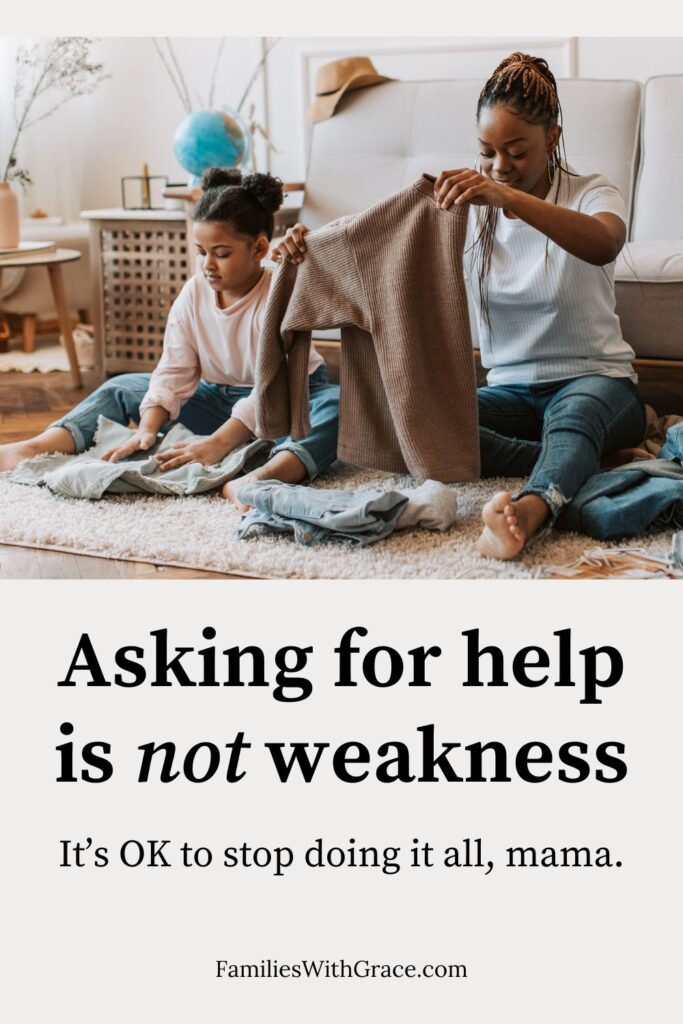
I want to gently push back on that, because I’ve lived on both sides of it. Asking for help isn’t a sign that we’re failing. Most of the time it’s a sign that we’re paying attention.
Why asking for help feels so hard
Asking for help goes against our pride and our deep wish to be independent and strong. We don’t want to admit we can’t do it all. We’d rather carry the whole weight, plaster on a smile and stumble around under it than say the words out loud: I need help.
For me, it has always been tangled up with the house. Early in our marriage, I realized I felt the most responsible for how our home looked to other people.
When things were in disarray — and they were, more often than not — I took it as a personal failure. Add two kids and some real health challenges, and that quiet shame had plenty to feed on.
It helps to name where that pressure actually comes from, because it isn’t from God. It’s from comparison, from the highlight reels, from an old story that says needing anything makes us less.
None of that is true. We were never built to do this alone.
Laying down the guilt
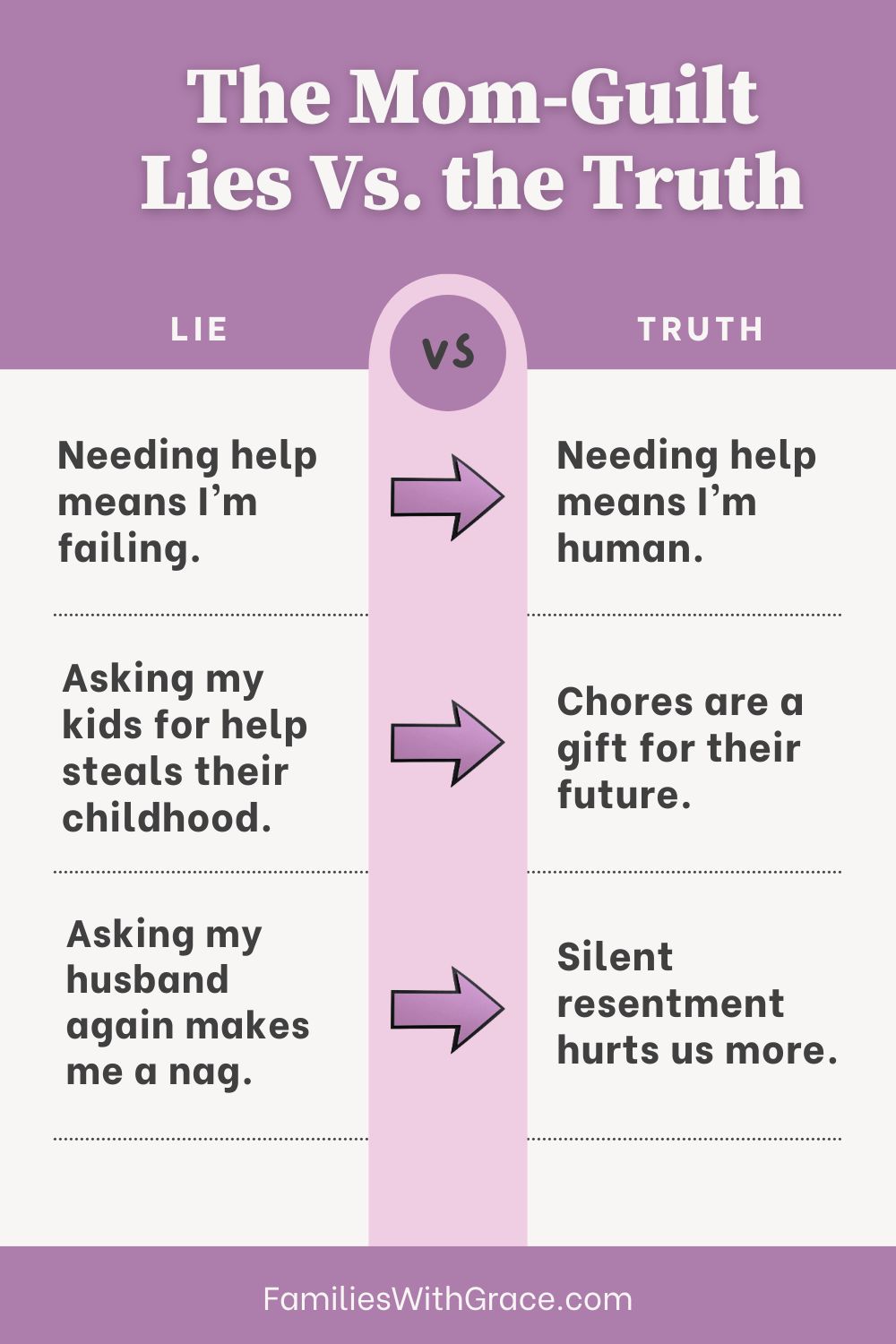
So much of this is guilt, and it runs deeper than we admit. As women, we’re often conditioned to believe we should do everything ourselves. We worry that asking makes us look weak.
And the guilt gets sharpest right where it should be softest: with our own families. Asking our kids or our husband for help can feel like proof that we’re failing at the one job we’re sure is ours alone.
We tell ourselves all kinds of things. That asking our kids to pitch in is stealing something from their childhood. That asking our husband one more time makes us a nag. That a good mom would just handle it.
We need to lay that guilt down, because most of it isn’t even true. Our kids don’t need a mom who does everything for them. They need to learn responsibility in age-appropriate ways, and a reasonable chore is a gift to their future, not a theft from their present.
And our husbands are not better off when we swallow the need and quietly stew. Resentment built up in silence does far more damage to a marriage than a clear, kind request ever could.
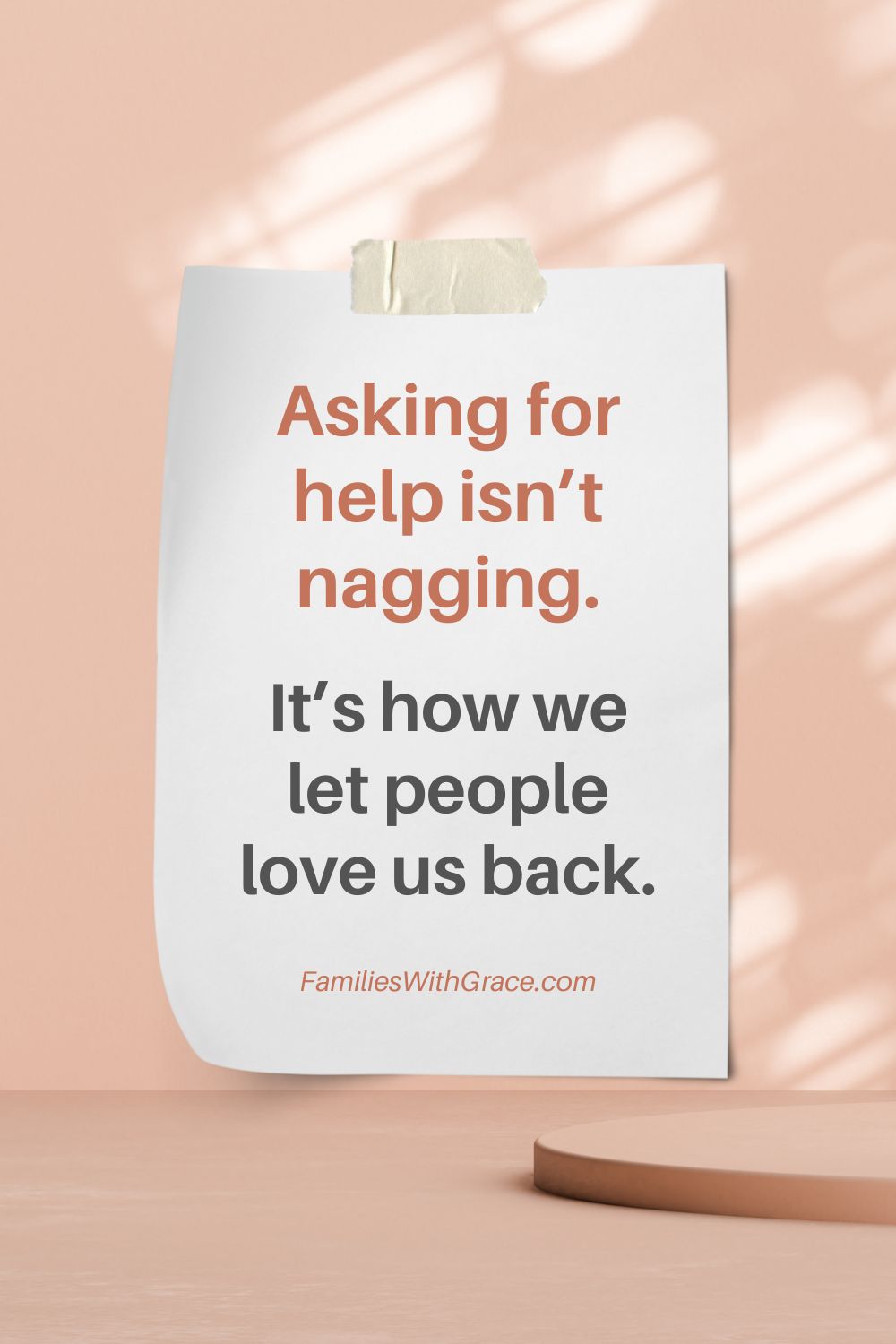
Asking isn’t nagging. Asking is letting the people who love us actually love us back.
I learned this the hard way
About 13 years ago, my mom and my mother-in-law came to my house nearly every day while I recovered from surgery. I had a preschooler and a baby, and I couldn’t lift the baby for six weeks.
The months leading up to that surgery had been brutal: three months “sleeping” in a recliner, shingles, two rounds of stomach flu, strep throat. My head was barely above water.
While they came to help with the kids, they also saw the drowning need at my house. I still remember them scrubbing my bathroom and my kitchen, and the wave of relief and gratitude I felt that those simple things were getting done, even though I couldn’t do them myself.
I mentioned it to a group of mom friends online. One of the first comments said she could never imagine letting someone else clean her bathroom. Ouch. She didn’t seem to understand that I had no other choice. I literally couldn’t do it.
My husband was holding all of us together and working full-time in another city. He couldn’t do it either. So I learned, slowly and reluctantly, to let go of my pride and ask.
These days the reason is named: fibromyalgia. My back, my hands, my arms — everything, really — has limited use on any given day. I work in small spurts to avoid tipping into a full flare.
I could start every deep-cleaning task in spring and still be at it in fall. So I made peace with a hard truth: I can’t do all of it, and pretending otherwise only hurts me.
Help looks different in every season
Here’s what I wish someone had told me sooner: help is not one thing, and it does not require money.
Some of mine is paid. Once a month, someone comes to do the deep scrubbing my body can’t manage anymore — the tubs, the floors, the baseboards. I’ll be honest, that took me a while to share, partly because I didn’t want anyone to think I have piles of disposable income (I don’t) or a full-time housekeeper (I don’t).
The everyday house cleaning tips I share are still the everyday things I really do. It’s the hard-core scrubbing I’ve had to hand off.
But most of my help costs nothing. My kids are 13 and 16 now, and they are fully capable of carrying their share. The catch is that they don’t see what I see.
A basket of laundry outside the laundry room is invisible to them until I say, clearly, “Please fold this laundry and put it away.”
Same with my husband. I’ve stopped waiting for people to notice and started asking them directly and specifically. That one shift changed more than any cleaning hack ever did.
And help can come from further out, too. Maybe you have a friend you trade childcare with, a neighbor who grabs something from the store, your people at church or the mom at school pickup who’s just as buried as you are. None of that requires a budget. It requires us to open our mouths and ask.
What God says about carrying the load
There’s a spiritual layer here that’s easy to miss. He never designed us to carry the weight of the world. He designed us to let Him carry it, and to let each other share it.
When Paul pleaded with God to remove a burden, the answer he got wasn’t relief, it was this: “But he said to me, ‘My grace is sufficient for you, for my power is made perfect in weakness'” (2 Corinthians 12:9, NIV).
Then Paul says something that still stops me: “For when I am weak, then I am strong” (2 Corinthians 12:10, NIV). Our limits aren’t the opposite of God’s strength. They’re the very place it shows up.
We also weren’t meant to do faith, or motherhood, alone.
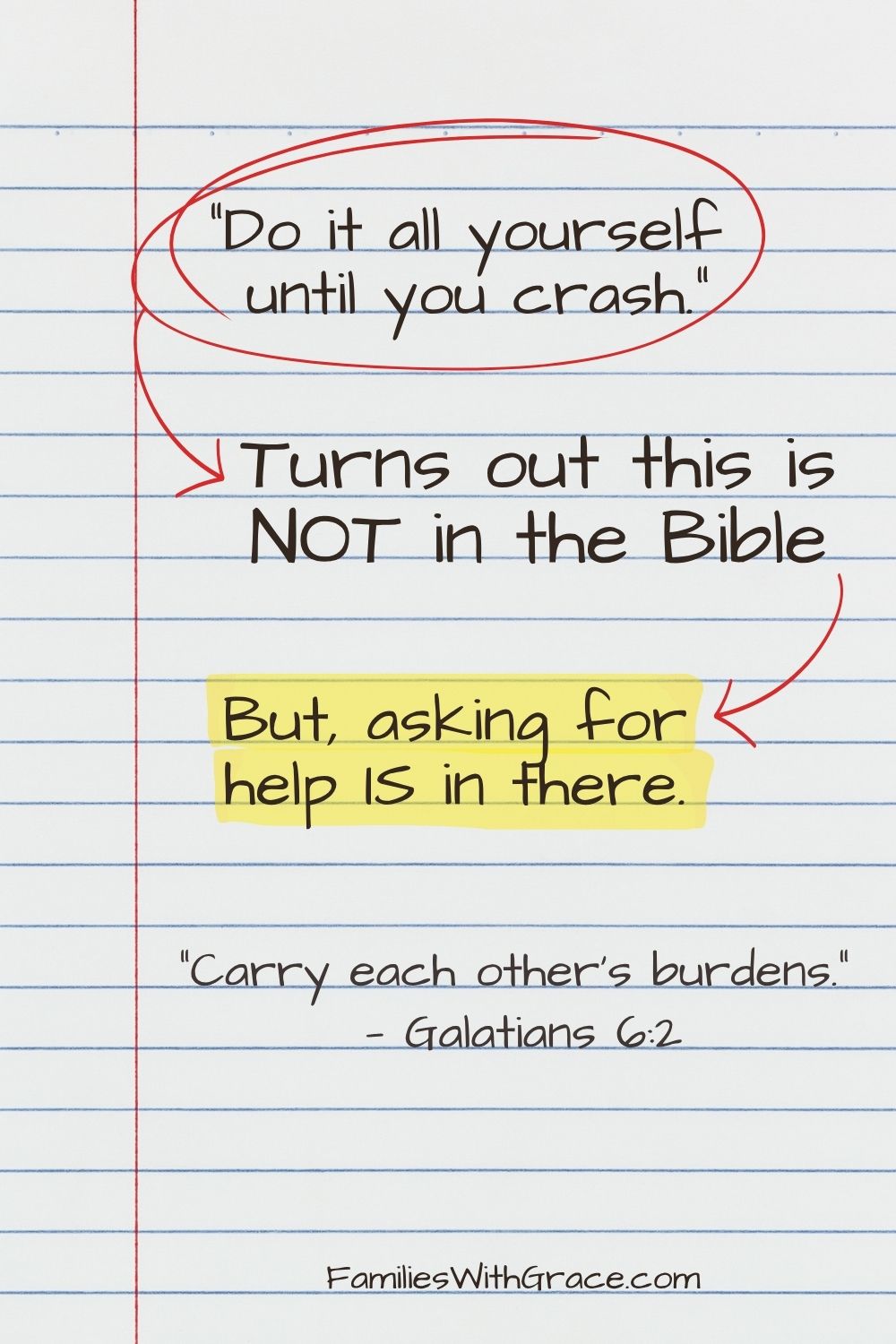
“Carry each other’s burdens, and in this way you will fulfill the law of Christ.”
Galatians 6:2, NIV
Notice that carrying each other is the whole point. When we let someone help us, we’re not failing the assignment. We’re living it out, and we’re giving them the gift of being needed.
How to actually ask for help
Knowing it’s OK to ask is one thing. Doing it is another. A few things that have made it easier for me, and might for you too:
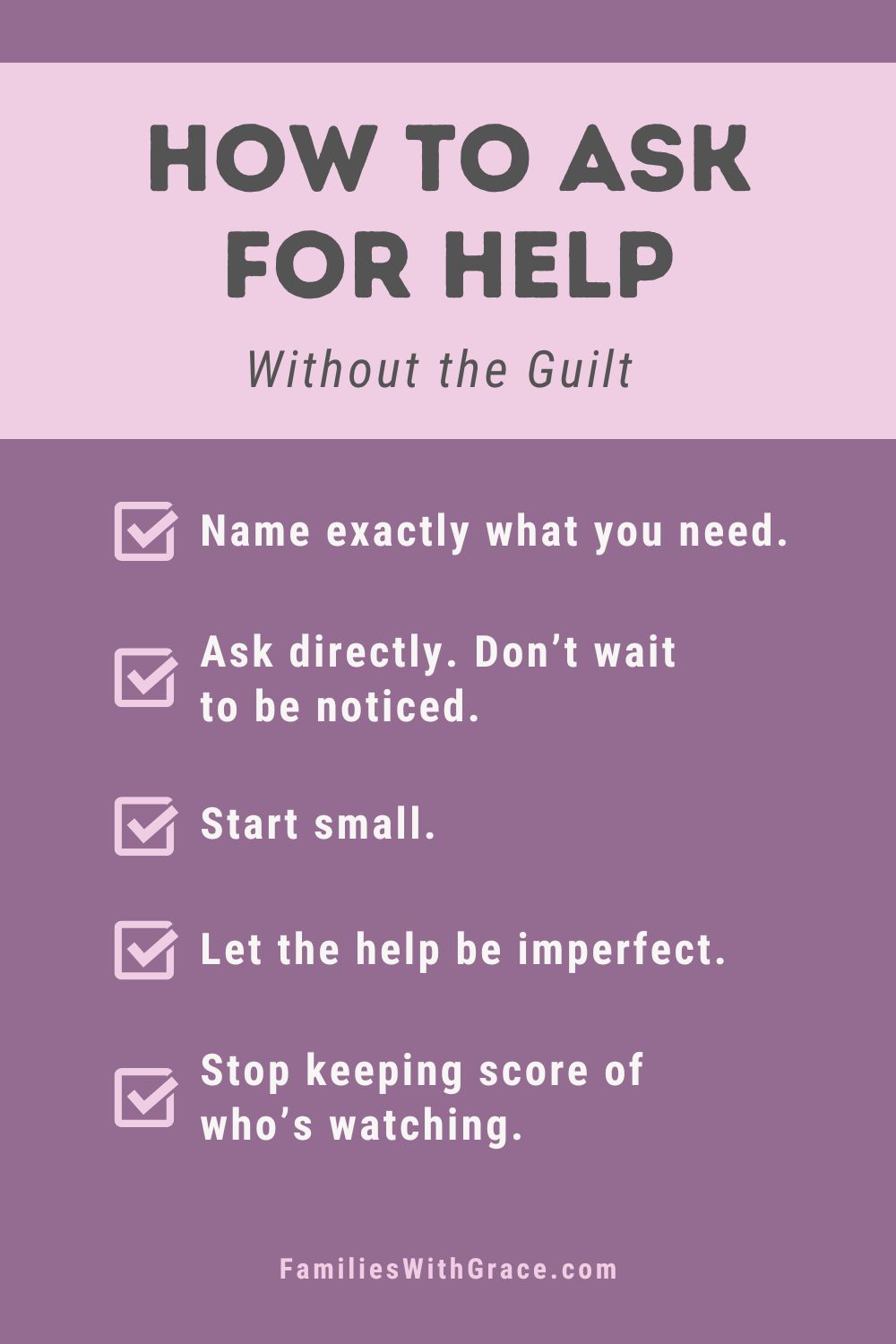
Name what you actually need.
“I need help” is too big to act on. “Could you handle bath time tonight?” or “Will you put away this laundry?” gives the other person something they can say yes to.
If I complain to my family that the house is a mess, not much gets done. If I ask for specific chores to be completed, then they do get done.
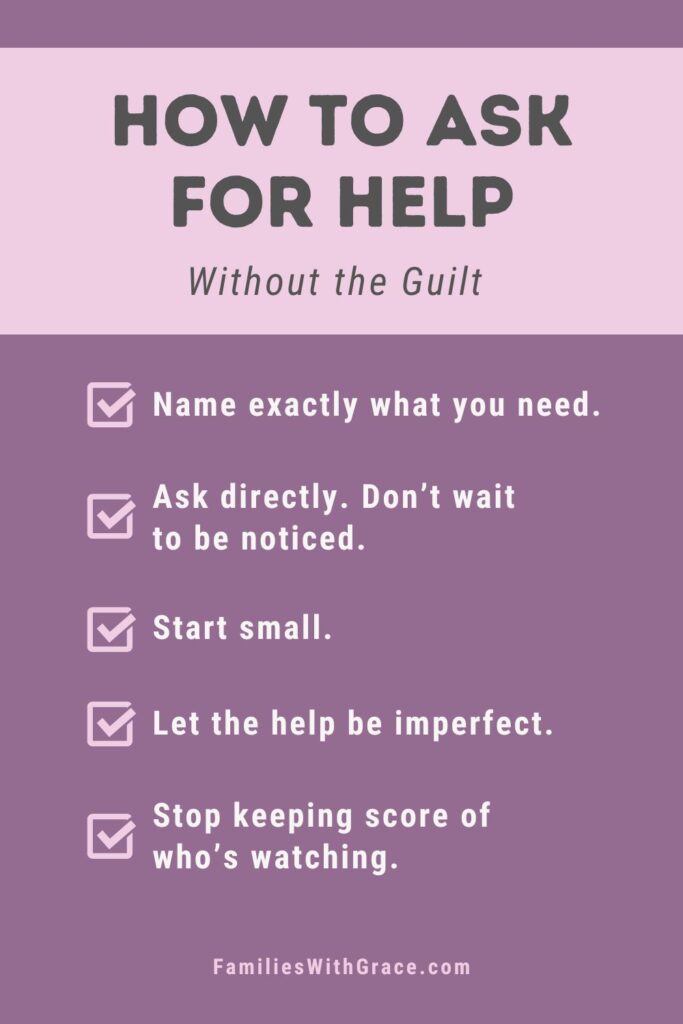
Ask directly — don’t wait to be noticed.
Our people aren’t ignoring us on purpose. They genuinely don’t see the mental list running in our heads. Saying it out loud isn’t nagging. It’s communicating.
I learned early on in marriage that my husband isn’t a mind reader. If I have a need, then it’s up to me to voice it.
Start small.
If asking feels impossible, pick one tiny thing this week and ask for it. Confidence grows from there.
You could start with something as simple as asking a friend to pray for a specific need you have this week.
Let the help be imperfect.
The towels may get folded wrong. The dishwasher may get loaded in a way that makes you twitch. Let it go. Done by someone else beats undone by no one.
My husband and kids fold towels differently than I do, so they don’t stack perfectly in our closets. I’ve learned to let it go, because after all, the towels are still clean, still folded and still put away. That’s what matters most.
Stop keeping score of who’s watching.
Anyone who would judge you for needing help isn’t carrying your load, and probably isn’t paying attention to the right things anyway.
Instead, think of how you’d react if the person you’re asking to help you asked you for a favor. Chances are really good you’d be happy to help. Assume the same of those around you.
You don’t have to do it all, mama
I still don’t love needing help. I’d rather be able to do it all myself.
But I’ve learned that my real options are to ask for help, hurt myself trying to do everything or leave it undone and stew about it.
So I choose to ask. I choose to release the things I can’t do and be thankful for the things I can.
Wherever you are, I’d bet there’s something you could use a hand with — and that’s not weakness. It’s just being human, which is exactly how He made us.
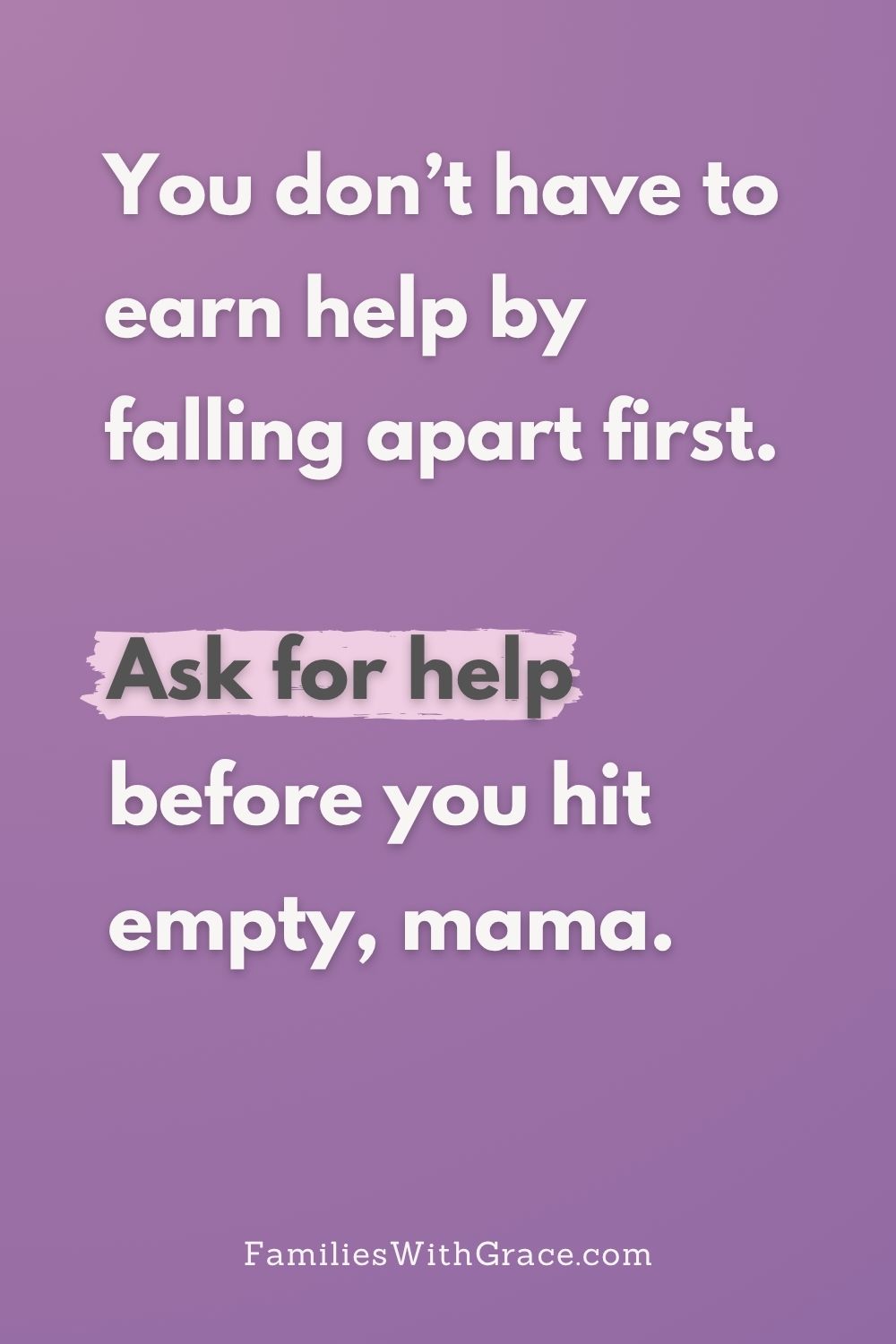
So this week, let go of one thing and ask. You don’t have to carry it all, and you were never supposed to.
And if what you really need isn’t help with the tasks but time away from the kids themselves, we’ll talk about that soon.
And sometimes the help we need isn’t with the dishes or the laundry at all. Sometimes we need a break from the kids themselves, and that’s its own kind of OK. If that’s where you are today, here’s Taking a break from your kids.
If you’re in a tired season, you might also like How to rest as a busy mom and this short devotional, A truth every stressed and overwhelmed mom needs to hear. And if you just need other moms who get it, you’re always welcome in our Moms with Grace community.