Letting go of hustle, comparison and burnout so your faith can feel life-giving again
A couple of months ago, I was struggling and having a hard time with overwhelm and burnout that made their way into my spiritual walk as well. I was going through a Bible reading plan and dreading the daily readings. I was stuck in a book of woe, and it was just hard to read.
Then one morning, I took a deep breath and realized that isn’t what God intended. Following a Bible reading plan and reading through the Bible in a year was a great goal, but it wasn’t the only way to connect with God.
I felt the Holy Spirit whisper to me to go off plan and read the book of Luke. I switched up my reading, and felt such a great relief. My preconceived idea of what Bible reading should look like in that season was getting in the way of my relationship with my Heavenly Father.
I worried I was disappointing God when all along, He just longed to bless and encourage me.
Maybe you’ve been there, too, and had a sinking feeling that your Christian faith has become just another task on your endless to-do list. Another area where you’re not measuring up. Another source of pressure in a life that already feels like too much.
But what if I told you that’s not what faith was ever meant to be?
What does faith without pressure actually mean?
Faith without pressure means living out your Christian faith from a place of grace and trust, not performance, comparison or constant striving.
Faith without pressure isn’t about lowering standards or caring less about your relationship with God. It’s about understanding what true faith actually looks like according to Scripture—not according to Instagram, not according to the mom at church who seems to have it all together and not according to the voice in your head that says you’re never doing enough.
In Matthew 11:28-30, Jesus says something that should change everything: “Come to me, all you who are weary and burdened, and I will give you rest. Take my yoke upon you and learn from me, for I am gentle and humble in heart, and you will find rest for your souls. For my yoke is easy and my burden is light.”
Read that again. Easy. Light. Rest. That’s God’s plan for our spiritual lives.
The truth is, God never intended for your relationship with Him to feel like a performance review. Faith without pressure means recognizing that you’re already loved, already accepted, already enough not because of what you do, but because of what Christ has done.
When faith starts to feel like hustle
Here’s what pressure-based faith looks like in real life:
You wake up feeling guilty because you didn’t get up early enough for a “proper” quiet time. You compare your prayer life to someone else’s and feel like you’re failing. You say yes to another church commitment even though you’re already drowning. You read Christian books about doing more, being more, achieving more for God.
You measure your spiritual health by how busy you are in ministry. You feel anxious when you rest because you “should” be doing something productive. You secretly wonder if God is disappointed in you. You’re exhausted, but you keep pushing because stopping feels like giving up on faith altogether.
Sound familiar?
This hustle mentality has infiltrated Christian culture so deeply that many of us can’t tell the difference between genuine faithfulness and religious performance anymore. We’ve confused being busy for God with actually knowing God. We’ve mistaken activity for intimacy.
But the pressure of life, including self-imposed spiritual pressure, wasn’t meant to define our walk with Christ. In fact, it often gets in the way.
Galatians 3:3 asks a piercing question: “Are you so foolish? After beginning by means of the Spirit, are you now trying to finish by means of the flesh?”
We start with grace, but then we slip into striving. We begin in freedom, but end up in bondage to our own expectations.
The comparison trap that steals our peace
Social media has made comparison a constant temptation. You see another mom’s beautiful Bible journaling spread and feel inadequate about your scribbled notes.
You watch someone’s morning routine video—complete with an hour of worship, prayer and Scripture memory while being dressed just so and making bread from scratch—and wonder what’s wrong with you for struggling to read one chapter while your toddler dumps cereal on the floor.
But here’s the thing about comparison: it’s always based on incomplete information. You’re comparing your full reality of the messy kitchen, the forgotten prayers, the days when faith feels hard with someone else’s highlight reel.
Great faith isn’t measured by how much you do or how perfect your spiritual practices look. In Luke 18:9-14, Jesus told a parable about two men praying. The Pharisee stood and prayed about himself, listing all his spiritual accomplishments. The tax collector simply beat his breast and said, “God, have mercy on me, a sinner.” Jesus said it was the tax collector who went home justified before God.
The one who came with nothing but honest need. The one who wasn’t performing. The one who simply trusted in God’s mercy.
That’s what God is looking for: trust. Not performance.
Comparison also distorts our understanding of what God is actually asking of us. Your calling, your season and your circumstances are uniquely yours.
God isn’t asking you to be that other mom. He’s inviting you to be faithful right where you are, with what you have, in this moment.
We are all different with different personalities, skillsets and passions. Outside pressure to be like someone else just doesn’t fit.
Understanding true faith vs. works-based faith
This is where things get really important. We need to talk about the difference between true faith and faith that’s actually just works dressed up in spiritual language.
Ephesians 2:8-9 makes it crystal clear: “For it is by grace you have been saved, through faith—and this is not from yourselves, it is the gift of God—not by works, so that no one can boast.”
We can’t earn our way into God’s love. We can’t pray enough, serve enough or be good enough to make God love us more. He already loves us completely. That’s grace.
But many of us still operate as if we have to prove ourselves. We’ve intellectually accepted grace, but we’re emotionally still stuck in a works-based mindset. We think if we just do more good works, we’ll finally feel secure in God’s love. If we just try harder, we’ll finally feel like we’re good Christians.
That’s exhausting. And it’s not what God’s word teaches.
True faith is trusting God even when we don’t understand. It’s believing His promises when circumstances look impossible. It’s resting in His grace instead of striving for His approval. It’s showing up honestly with our doubts, our struggles and our real selves instead of pretending to have it all together.
Romans 5:1-2 reminds us that “since we have been justified through faith, we have peace with God through our Lord Jesus Christ, through whom we have gained access by faith into this grace in which we now stand.”
Peace. Access. Grace in which we stand, not grace we’re scrambling to reach.
How grace replaces the pressure to perform
Grace is the game-changer. It’s what transforms Christian faith from a burden into a gift.
When you truly grasp grace, you realize God isn’t standing over you with a clipboard, marking down every spiritual failure. He’s not disappointed when you’re too tired for daily prayer.
He’s not comparing you to other Christians. He sees you through the lens of Christ’s finished work on the cross, and He sees you as beloved.
This is where the Holy Spirit becomes so important. The Holy Spirit isn’t some divine taskmaster pushing you to do more.
The Spirit is God’s presence with you, empowering you, comforting you and guiding you through love, not guilt.
When you live in grace, you stop asking, “What do I have to do to be acceptable to God?” and start asking, “What is God inviting me into today?” That shift changes everything.
Grace doesn’t make us lazy. Actually, the opposite happens. When we stop exhausting ourselves trying to earn love we already have, we discover the energy and freedom to love others genuinely.
We serve from overflow instead of obligation. We find deeper trust developing naturally as we spend time with God because we want to, not because we have to.
Titus 3:4-5 beautifully captures this: “But when the kindness and love of God our Savior appeared, he saved us, not because of righteous things we had done, but because of his mercy.”
Not because of what we did. Because of His mercy.
Recognizing and healing from faith burnout
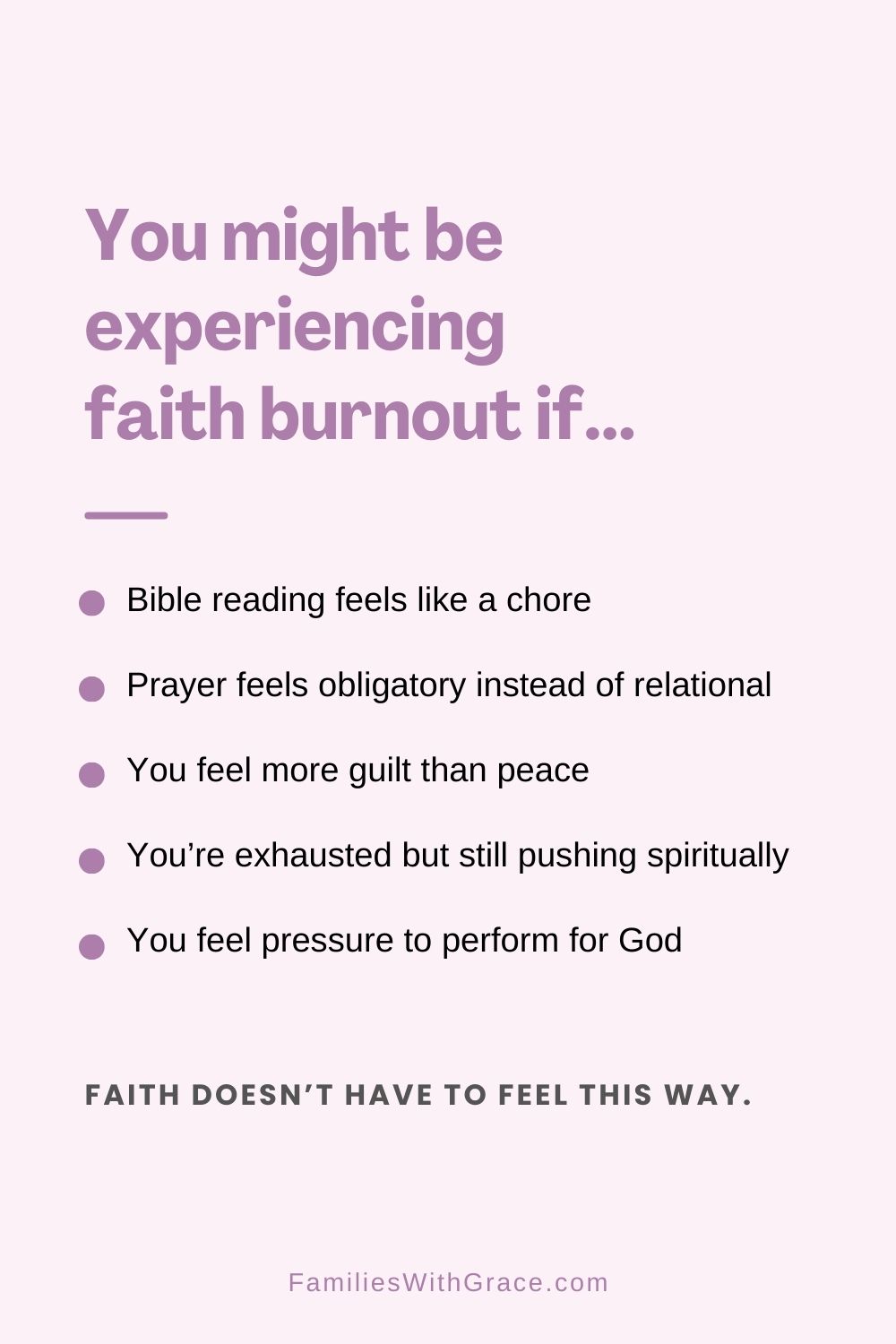
Faith burnout is real, and it’s more common than you might think. It happens when the pressures of life combine with unrealistic spiritual expectations to create a perfect storm of exhaustion.
You might be experiencing faith burnout if:
- Reading your Bible feels like a chore instead of a delight
- Prayer feels obligatory rather than conversational
- You feel guilty more often than you feel loved by God
- Church attendance drains you instead of refueling you
- You’re going through the motions but feeling spiritually numb
- You secretly wonder if you’re cut out for this faith thing at all
If that’s you, please hear this: God is not disappointed in you. He sees your weariness, and He’s inviting you to rest.
In Mark 6:31, Jesus told His disciples, “Come with me by yourselves to a quiet place and get some rest.”
This was after they’d been busy serving and ministering. Jesus didn’t say, “Push through! Do more!” He invited them to rest.
You’re allowed to rest. You’re allowed to have seasons where you can’t do it all. You’re allowed to step back from commitments. You’re allowed to admit you’re tired.
God isn’t asking you to run yourself into the ground for Him. He’s asking you to abide in Him (John 15:4). Abiding isn’t hustle; it’s presence and staying connected. It’s letting His life flow through you instead of trying to manufacture spiritual fruit through sheer willpower.
Hebrews 4:9-10 offers this beautiful promise: “There remains, then, a Sabbath-rest for the people of God; for anyone who enters God’s rest also rests from their works, just as God did from his.”
God invites us to rest from our works. Not to prove ourselves through them.
Burnout often shows up most clearly when life is already hard, which is why pressure-based faith becomes especially damaging in difficult seasons.
Faith during hard times doesn’t mean faking strength
When life gets difficult, pressure-based faith tells you to put on a brave face, have all the answers and demonstrate unshakeable confidence. But that’s not what faith during hard times actually looks like in Scripture.
Look at the Psalms. David was brutally honest with God. He complained. He questioned. He expressed fear and doubt and anger. And God called David a man after His own heart.
Real faith doesn’t mean pretending everything’s fine. It means bringing your real self to a real God who can handle your real emotions.
Faith during hard times means showing up even when you don’t feel strong. It means crying out to God even when you’re not sure He’s listening and admitting you need help. It means clinging to what you know about God’s character even when your circumstances are screaming the opposite.
This kind of honest, pressure-free faith actually creates space for God to work. When we stop trying to be superhuman, we make room for God to be God.
Isaiah 30:15 says it perfectly: “In repentance and rest is your salvation, in quietness and trust is your strength.”
Not in doing more. In rest. In quietness. In trust.
What a simple, grace-filled faith actually looks like
So what does faith without pressure look like practically? What changes when we let go of the hustle and embrace grace?
It might look like having a two-minute conversation with God while you’re folding laundry instead of beating yourself up for not having an hour-long quiet time.
It might mean reading one verse and sitting with it all day instead of rushing through three chapters to check a box.
It could be praying honest, messy prayers—”God, I’m so tired. I don’t even know what to say. Help”—instead of trying to pray “properly.”
A transformed life doesn’t happen through pressure and striving. It happens through consistent, grace-filled connection with God over time. Small steps. Daily choices. Honest conversations.
When we approach faith this way, something beautiful happens. We start to actually enjoy God’s Word instead of feeling obligated to read it.
Prayer becomes a lifeline instead of a duty. We develop deeper trust naturally as we see God show up faithfully in small ways.
And slowly, without us even noticing at first, we’re transformed. Not because we followed the perfect formula, but because we spent time with the One who transforms.
The freedom of seeking first
Matthew 6:31-33 addresses our tendency to worry and strive: “So do not worry, saying, ‘What shall we eat?’ or ‘What shall we drink?’ or ‘What shall we wear?’… But seek first his kingdom and his righteousness, and all these things will be given to you as well.”
Seek first. Not seek perfectly. Not seek constantly while ignoring everything else. Just seek first, make Him the priority and trust Him with the rest.
This is where so much pressure melts away. When we’re focused on striving for God’s approval, we carry the weight of our performance. But when we simply seek His kingdom first, trusting that He’ll provide what we need, we find freedom.
God isn’t asking for perfection. He’s asking for priority. And there’s a world of difference between the two.
Practical steps toward pressure-free faith
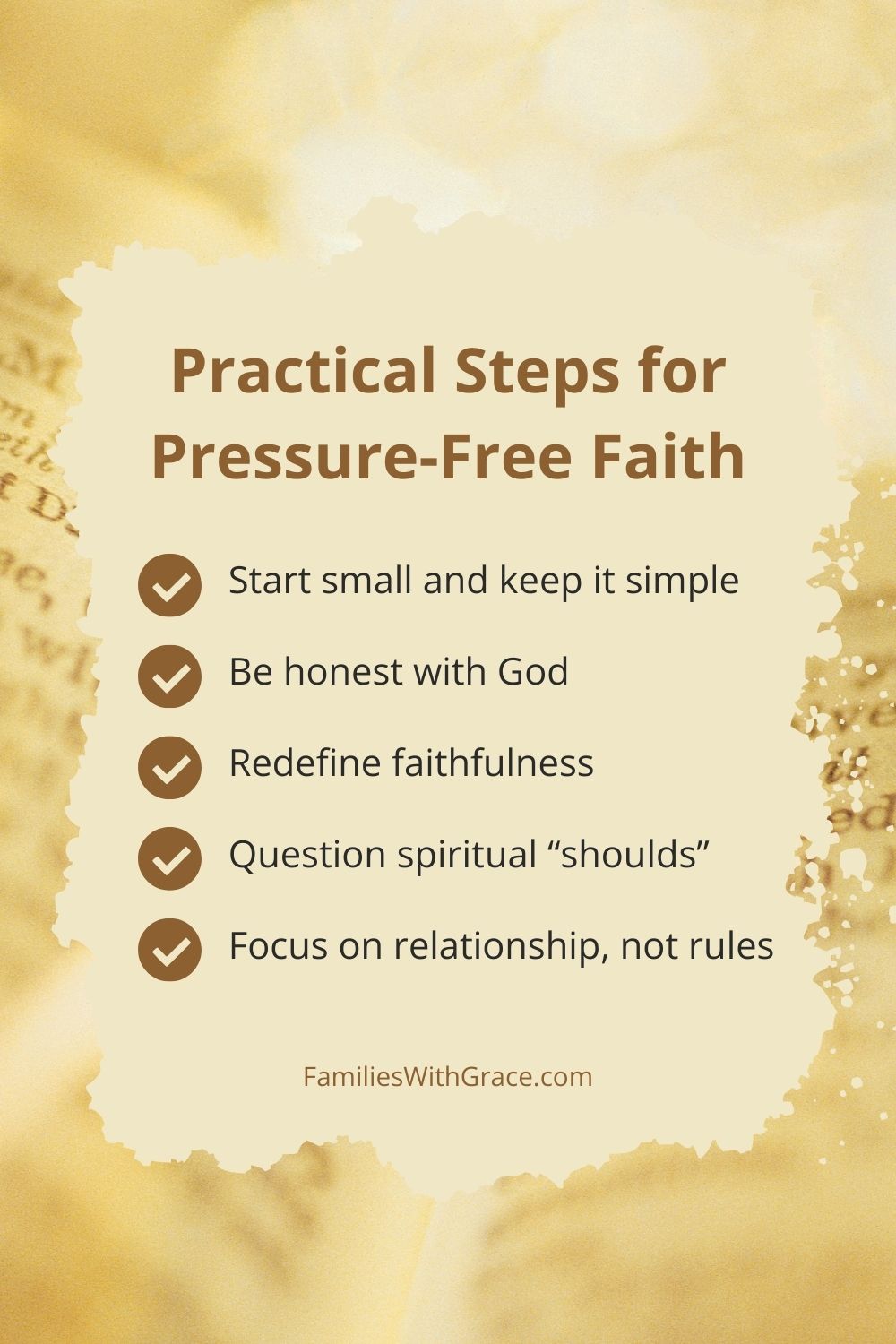
Here are some gentle, practical ways to start releasing pressure and embracing grace:
Start small. Instead of committing to an hour of prayer, start with five minutes. Instead of a detailed Bible study plan, read one passage slowly or use a simple Bible reading plan with just a verse or two per day. Small, consistent steps build sustainable rhythms.
Be honest with God. Stop trying to pray impressive prayers. Tell Him how you really feel. He already knows anyway.
Redefine faithfulness. Faithfulness isn’t about perfection. It’s about showing up, even imperfectly. It’s about returning to God again and again, not about never struggling.
Question the “shoulds.” When you hear yourself thinking “I should be doing more,” stop and ask: Is this actually from God, or is this comparison, culture or condemnation talking?
Give yourself grace. Extend to yourself the same grace God extends to you. You’re not a project to be fixed. You’re a beloved child learning and growing.
Focus on relationship, not rules. God wants your heart, not your religious performance. Time with Him is about connection, not just checking boxes.
James 1:5 offers this encouragement: “If any of you lacks wisdom, you should ask God, who gives generously to all without finding fault, and it will be given to you.”
Without finding fault. God doesn’t condemn you for needing help. He gives generously.
An invitation to rest in faith together
If you’ve been living under the weight of pressure-based faith, I want you to know: there’s a better way. A way that honors God without crushing you. A way that leads to genuine transformation without the burnout.
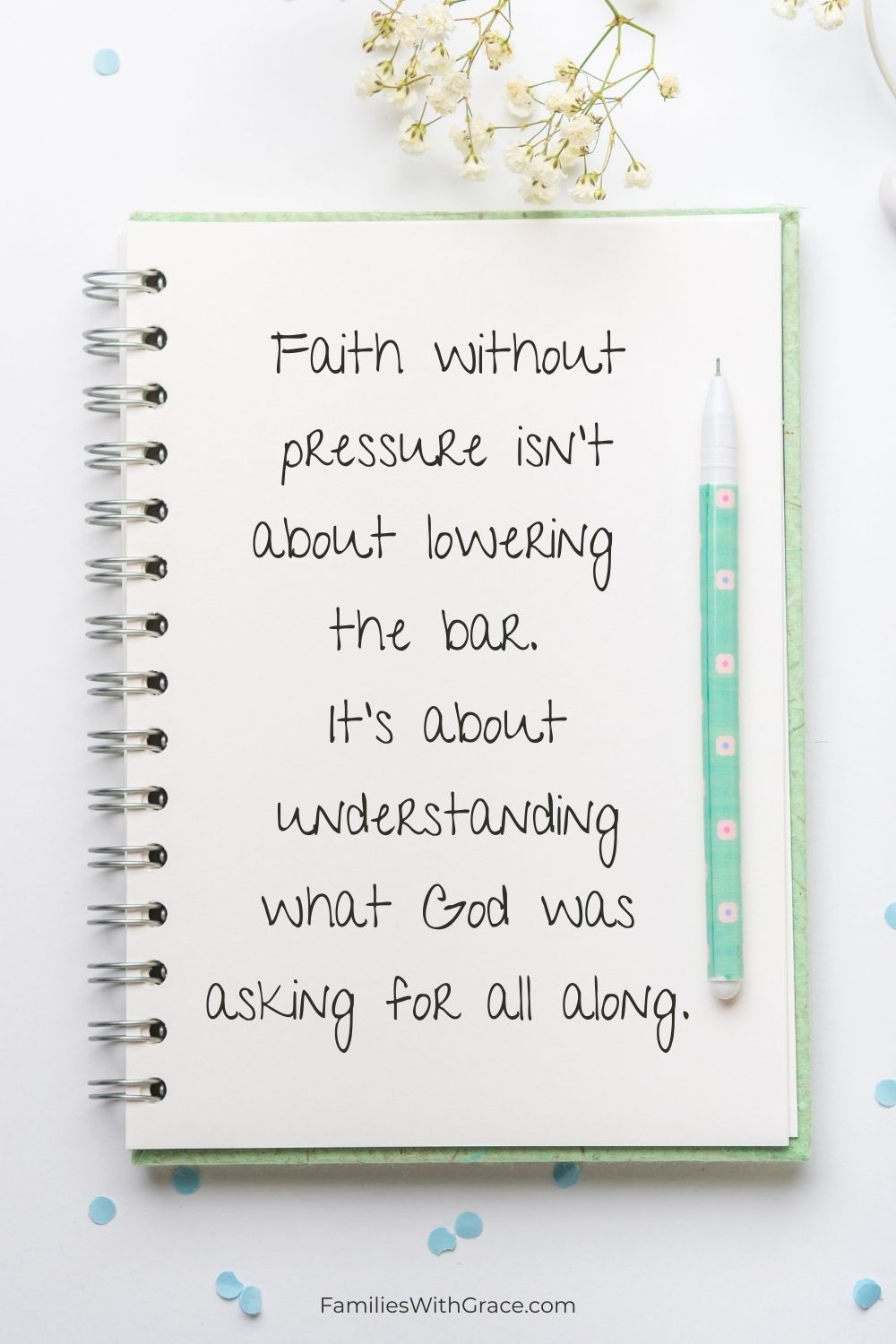
Faith without pressure isn’t about lowering the bar. It’s about understanding what God was actually asking for all along. Not perfection. Not performance. Just you. Your real, honest, imperfect, beautiful self, trusting in His grace.
If you’re tired of the hustle and ready to experience Christian faith the way it was meant to be—rooted in grace, marked by rest and full of genuine joy—I’d love to invite you to join a Bible study we’re doing on this very topic.
This isn’t another thing to add to your plate. It’s not about homework or obligation. It’s a space where we can explore together what it means to live in grace, to trust God more deeply and to let go of the pressures that have been weighing us down.
We’ll dig into Scripture together, share our real stories and discover practical ways to embrace faith without pressure in our everyday lives.
No performance required. No comparison allowed. Just honest women learning to rest in God’s love together.
Because here’s what I’ve learned: faith without pressure isn’t just possible, it’s what God has been offering all along. We just needed permission to receive it.
And sweet mama, consider this your permission.
God isn’t waiting for you to get it all together. He’s inviting you to come as you are—tired, imperfect, struggling—and find rest in Him. That’s where the transformed life begins. Not in the striving, but in the surrender. Not in the pressure, but in the peace.
Will you join us?
Read more from the series:
Faith burnout: When your relationship with God feels heavy